
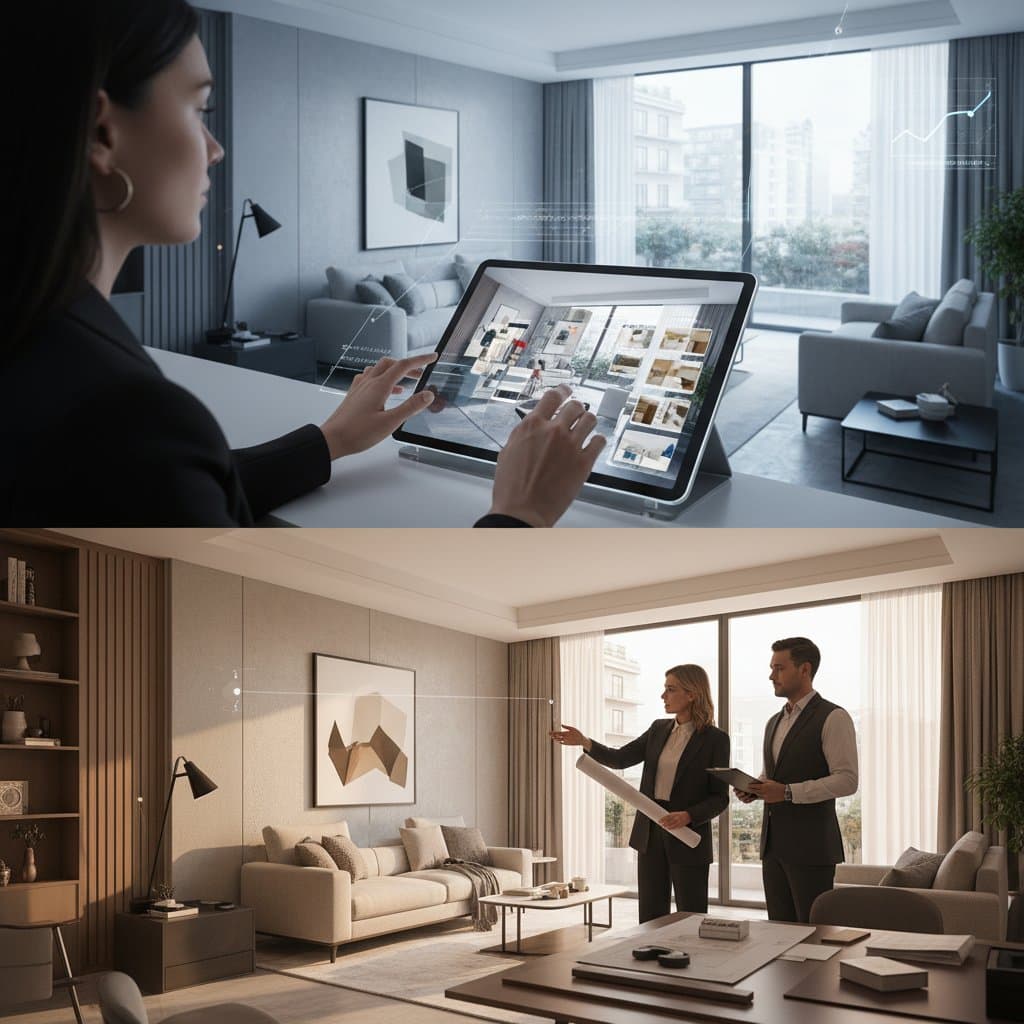
AI Versus Professional Designers: Maximizing Savings in 2026
Homeowners in 2026 face a clear choice between artificial intelligence tools and professional designers for interior projects. Artificial intelligence offers rapid visualizations and cost estimates, yet professional designers provide unmatched precision and oversight. The optimal strategy involves integrating both approaches to achieve substantial savings while ensuring quality outcomes.
This article examines the strengths of each method, outlines actual expenses, and details steps to combine them effectively. Readers gain practical insights to inform decisions that balance efficiency with reliability.
Understanding AI Design Tools
Contemporary AI platforms for interior design employ advanced algorithms and computer vision to process images of existing spaces. These systems evaluate dimensions, suggest furniture arrangements, and generate realistic renderings based on user inputs such as preferred styles and color palettes. Users upload photographs via mobile devices, and the software delivers comprehensive proposals, including fixture recommendations and material options, in mere moments.
Key capabilities include automated room measurements captured through device cameras, analysis of current decor to align suggestions with personal tastes, seamless links to e-commerce sites for procurement, and side-by-side comparisons of multiple design schemes. Such features accelerate the ideation phase significantly. A task that requires days of consultation with a designer completes in minutes, allowing homeowners to explore numerous concepts without immediate financial commitment.
However, limitations persist in handling complex variables. AI struggles with nuances like irregular wall angles, hidden wiring configurations, or fluctuating natural light patterns throughout the day. These inaccuracies may lead to rework during implementation, potentially inflating budgets by unforeseen amounts.
Implementing a Hybrid Design Strategy
Most effective projects leverage AI for initial exploration and professionals for refinement. This combination harnesses technology for affordability and speed while incorporating human judgment for accuracy. Homeowners retain oversight of creative elements, supported by expert validation.
Follow these steps to integrate the approaches successfully:
- Initiate withvisuals: Submit room images to a platform to experiment with layouts, hues, and furnishings.
- Develop a preliminary budget: Review generated inventories to calculate expenses for items and labor.
- Engage a designer for validation: Present the AI output for assessment of practicality, including compatibility with space constraints and regulatory requirements.
- Iterate usingIncorporate designer feedback into the tool to produce revised renderings and adjusted plans.
This iterative process empowers users to refine ideas iteratively. For instance, AI might propose a bold accent wall, but a designer could adjust it to account for room acoustics or ventilation needs. The result minimizes risks associated with purely automated decisions.
Avoiding Pitfalls in AI-Driven Design
Reliance solely on AI invites errors that compromise project success. Homeowners must recognize these issues to protect investments.
Frequent oversights encompass:
- Inaccurate light simulations: Digital previews assume uniform illumination, disregarding shadows from windows or fixtures.
- Neglected movement dynamics: Virtual arrangements may appear spacious online yet restrict navigation in physical settings.
- Disregard for compliance: Tools seldom reference zoning laws, fire codes, or accessibility standards.
- Subpar material selections: Recommendations favor low-cost options that degrade over time, leading to premature replacements.
To mitigate these, cross-verify all AI suggestions with certified professionals and consult local authorities early. Such diligence prevents costly corrections, such as reconfiguring electrical outlets or sourcing durable alternatives.
Evaluating Costs Over Time
Initial outlays for AI tools range from free basic versions to subscription models costing 10 to 50 dollars monthly, far below designer fees that start at 100 dollars per hour. AI eliminates travel and multiple meeting expenses, enabling remote planning. Yet, unaddressed flaws from AI can escalate total costs through remediation.
Professional designers, by contrast, invest time in site visits and custom solutions, averting issues like mismatched scales or incompatible installations. Their expertise often yields durable results, reducing maintenance expenses years ahead. Data from recent industry surveys indicate that hybrid projects cut overall budgets by 20 to 30 percent compared to traditional methods alone.
Strategic AI use accelerates choices, curtails unnecessary iterations, and aligns spending with priorities. Homeowners who pair it with designer input experience streamlined timelines and enhanced satisfaction.
Sustaining Design Investments
Post-completion, ongoing care preserves both aesthetics and utility. AI platforms assist by monitoring product lifespans, alerting to warranty expirations, and proposing timely updates aligned with evolving preferences. Professionals offer tailored maintenance protocols, such as cleaning schedules for textiles or adjustment guides for smart lighting.
A blended methodology ensures enduring benefits. Technology democratizes access to innovative ideas, while human insight guarantees adaptations to lifestyle changes. Homeowners achieve spaces that evolve gracefully, delivering sustained value without excessive upkeep.