
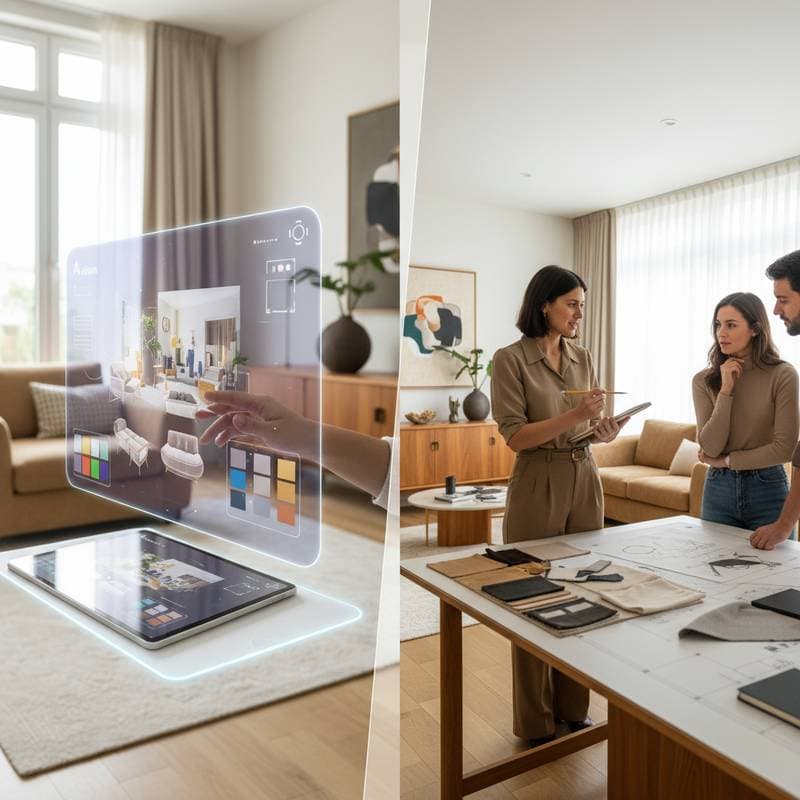
AI Versus Professional Designers: The Smart Choice for 2026 Homes
Many homeowners gaze at their living room and sense that an element lacks harmony, yet struggle to identify it precisely. AI home design tools address this challenge through simple interactions. Users upload photographs, specify budgets, and receive suggestions for color schemes, furniture arrangements, and illumination strategies within moments. Professional designers, however, contribute specialized knowledge, individual flair, and irreplaceable human perspective. The essential consideration remains which method aligns best with specific home needs and personal routines.
Capabilities of AI Design Tools
AI platforms for home design demonstrate remarkable intelligence. These systems analyze room measurements, images, and user preferences to produce lifelike visualizations swiftly. Homeowners can preview new flooring options or evaluate multiple blue tones for a bedroom without physical alterations.
Key features encompass:
- Three-dimensional room renderings with precise proportions
- Alignment of styles using provided inspiration images
- Suggestions for furniture positioning
- Projections of expenses alongside procurement lists
Basic previews appear in free editions, while advanced subscriptions cost between $20 and $100 per room, varying by complexity and collaborations with manufacturers. This represents a minimal portion of professional consultation fees.
AI tools facilitate risk-free exploration. Individuals observe the impact of a deep green accent wall prior to purchasing supplies or rearranging items. Such immediate responses build assurance in selections and minimize potential financial errors.
Advantages of Professional Designers
Engaging a professional designer establishes the benchmark for creating unified, practical, and customized environments. Designers exceed aesthetic enhancements by resolving underlying issues. For instance, a narrow hallway may appear confined due to suboptimal lighting, or a sofa might dominate the space through mismatched scale. Professionals detect these subtleties at once.
Benefits include:
- Thorough spatial planning that accounts for movement patterns and ergonomics
- Sourcing of premium materials and vendor-exclusive products
- Oversight of collaborations with builders, electricians, and decorators
- Perceptive understanding of lifestyle dynamics beyond mere ornamentation
Fees typically range from $1,000 for a single-room assessment to over $10,000 for comprehensive home transformations, influenced by region and project scale. Although substantial, this expenditure often averts larger costs from flawed material decisions or configurations.
Integrating AI and Professional Expertise
The most effective strategy involves neither exclusive reliance on AI nor designers alone, but their synergy. Numerous professionals incorporate AI into routines. They generate preliminary renderings for rapid ideation, followed by refinements through expert analysis.
For limited budgets, AI assists in clarifying aesthetic inclinations before designer engagements. Consultations then concentrate on innovative solutions rather than preliminary explorations. This collaboration optimizes time and resources.
Selecting the Appropriate Approach
Consider these critical factors:
- Project complexity: Simple rearrangements suit AI tools, whereas structural modifications require designer involvement.
- Financial constraints: Commence with AI if resources prove limited; engage professionals subsequently for refinements.
- Personal style assurance: AI empowers independent experimentation for confident users, while professionals guide those seeking direction in realizing visions.
Homeowners frequently benefit from AI in ideation phases and designers in implementation. Equilibrium hinges on technological familiarity and desired personal involvement.
Steps to Implement Your Vision
Begin by testing select AI platforms. Experiment with configurations, surfaces, and illumination to identify appealing elements. If outputs approach ideals yet require adjustment, schedule a professional consultation. Present generated concepts to streamline joint efforts.
Regardless of the selected route, the objective centers on developing a residence that reflects personal identity. Contemporary resources eliminate the need for division. Employ technology for logistical aspects, complemented by professional or intuitive enhancements for depth and character. Through algorithms or craftsmanship, the result yields an authentic living environment.