
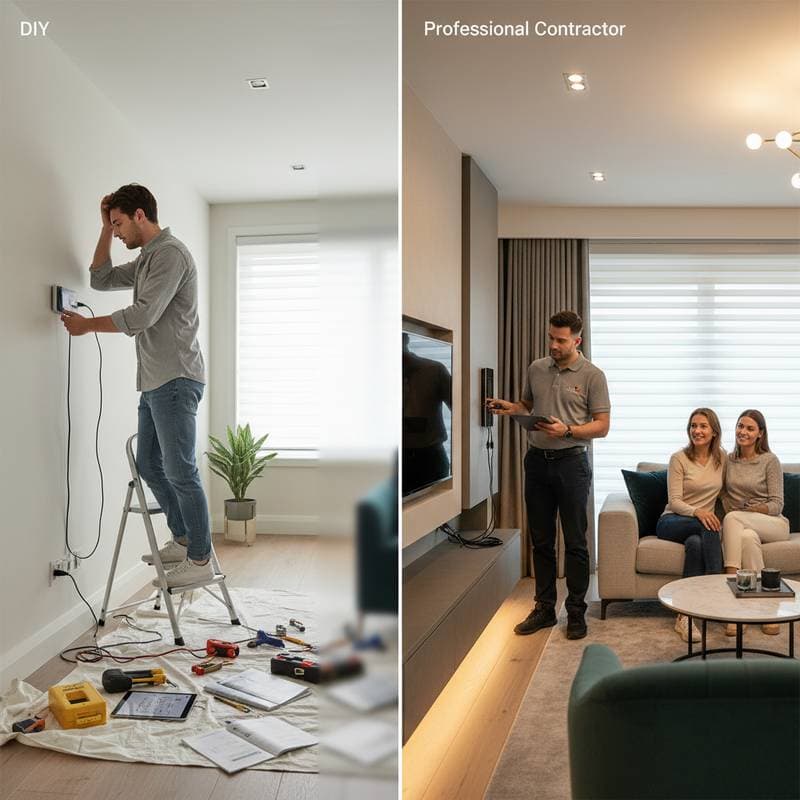
DIY Smart Home: When Professionals Outperform Self-Installation Challenges
Individuals who have attempted to install a smart thermostat or link a doorbell camera that fails to synchronize understand the blend of enthusiasm and irritation inherent in DIY smart home projects. The concept appears straightforward: connect the device, pair it with the network, and gain control over an intelligent living space through voice commands or mobile applications. In practice, challenges frequently emerge, including device incompatibilities, intricate wiring configurations, and extended periods dedicated to resolving application and router malfunctions.
This guide delineates scenarios where pursuing the DIY approach proves effective and situations where engaging a professional installer conserves time, finances, and mental effort. Readers will gain insights into evaluating project complexity, projecting accurate expenses, and identifying the specialized knowledge required for various systems.
Understanding the Smart Home Ecosystem
A smart home system integrates hardware components, software applications, and network connections to enable automation and oversight of lighting, temperature regulation, security measures, and entertainment options. The primary complexity arises not from individual devices but from their intercommunication protocols.
Three principal layers warrant consideration:
- Device level: Items such as light bulbs, smart plugs, and surveillance cameras that link through Wi-Fi or Bluetooth connections.
- Platform level: Central applications or hubs that manage multiple devices, including Alexa, Google Home, or Apple HomeKit.
- Integration level: Comprehensive setups that synchronize operations via routines, sensors, and activation triggers, frequently necessitating expert calibration.
As integration depth increases, the advantages of professional installation become more pronounced, ensuring seamless functionality and scalability.
When Professional Installation Proves Essential
Certain smart home enhancements enter realms where specialized knowledge proves indispensable. These initiatives typically encompass electrical wiring, data synchronization, or mechanisms influencing safety and energy conservation.
Complex Smart Systems Requiring Expert Intervention
| System Type | Reasons for Professional Involvement | Typical Installation Cost | Estimated Duration |
|---|---|---|---|
| Hardwired security cameras | Entails routing cables through structural elements and linking to a centralized hub | $800 to $2,000 | 1 to 2 days |
| Smart thermostats with HVAC integration | Demands electrical connections and precise system tuning | $300 to $700 | 2 to 4 hours |
| Whole-home lighting automation | Involves circuit merging and custom programming | $1,000 to $3,000 | 1 to 3 days |
| Home theater systems | Requires audiovisual fine-tuning and organized cabling | $500 to $1,500 | 1 day |
| Smart irrigation setups | Includes exterior wiring and integration with water controls | $300 to $800 | 4 to 6 hours |
Professionals evaluate a residence's architectural features, electrical infrastructure, and network reliability prior to commencement. Such assessments avert expensive errors, including circuit overloads or brand-specific compatibility disputes.
To determine necessity, calculate potential DIY pitfalls: for instance, a miswired thermostat might lead to HVAC inefficiencies costing hundreds in energy bills annually. Professionals also future-proof installations by incorporating expandable wiring conduits, reducing the need for disruptive retrofits later.
Safety and Security Considerations
DIY smart home endeavors occasionally introduce concealed dangers. Minor errors, like attaching wires to incorrect terminals or employing mismatched power supplies, may result in equipment failure or hazardous conditions.
Critical indicators signaling the need for professional assistance:
- Deployment of devices interfacing directly with electrical distribution panels.
- Placement of cameras or sensors in exterior locations susceptible to environmental moisture.
- Synchronization of components regulating heating, ventilation, air conditioning, gas lines, or plumbing.
Licensed installers adhere to regional construction regulations and manufacturer warranty stipulations. Numerous producers validate warranties solely for installations performed by certified technicians, safeguarding investments against voided coverage.
Beyond immediate risks, professionals implement robust cybersecurity measures, such as encrypted network configurations, to protect against unauthorized access. Homeowners attempting these integrations without guidance often overlook firmware vulnerabilities that expose personal data.
Selecting an Appropriate Smart Home Specialist
When deciding to hire, prioritize certified technicians experienced with the selected ecosystem. Request client testimonials and verify authorizations from entities like Nest, Ecobee, or Control4.
Essential inquiries to pose prior to engagement:
- Which brands and platforms form the core of your expertise?
- Does the service encompass ongoing technical assistance following setup?
- What protocols exist for managing software enhancements or system expansions?
- Do installations qualify for extended warranties or maintenance agreements?
Dependable specialists furnish detailed project outlines, expense itemizations, and projected timelines. Steer clear of providers offering ambiguous estimates or lacking verifiable credentials, as these often lead to escalated costs and incomplete results.
To streamline selection, compile a shortlist of three candidates and compare proposals side-by-side. Factor in their track record with similar projects in your locale, ensuring familiarity with local electrical standards and permitting requirements.
Addressing Frequent Challenges
Despite expert setup, disruptions may occur due to software glitches or environmental factors. Familiarity with foundational resolution techniques maintains operational efficiency.
Step-by-step troubleshooting for common problems:
- Connectivity failures: Restart the router and devices; verify Wi-Fi signal strength using a dedicated app to identify dead zones.
- Device unresponsiveness: Check battery levels or power sources; reset the unit by holding the designated button for 10 seconds before re-pairing.
- Integration conflicts: Review platform compatibility lists on manufacturer sites; temporarily disable conflicting routines to isolate issues.
- App errors: Clear cache and reinstall the application; ensure all devices operate on the latest firmware versions.
If initial attempts fail, document error codes and symptoms for professional review, minimizing downtime during support calls.
Sustaining Long-Term System Performance
Regular upkeep preserves the reliability and security of smart home investments. Implement these practices to extend device lifespan and optimize functionality.
- Conduct firmware updates monthly to mitigate emerging security threats and enhance performance.
- Affix labels to cables and central hubs, facilitating swift identification during maintenance or expansions.
- Arrange yearly evaluations of network infrastructure to confirm consistent signal propagation and bandwidth adequacy.
- Archive automation sequences digitally, enabling quick restoration after application overhauls or hardware replacements.
By integrating these habits, homeowners realize sustained energy savings and convenience. Professional periodic audits, scheduled biannually, can detect subtle degradations early, averting major overhauls and ensuring the system evolves with technological advancements.
Building a Resilient Smart Home Foundation
Equipped with these strategies, individuals can navigate DIY boundaries confidently while leveraging experts for intricate elements. This balanced approach yields a cohesive, secure environment that enhances daily life without overwhelming demands. Prioritize assessments and consultations to align installations with specific needs, fostering enduring satisfaction and efficiency.