
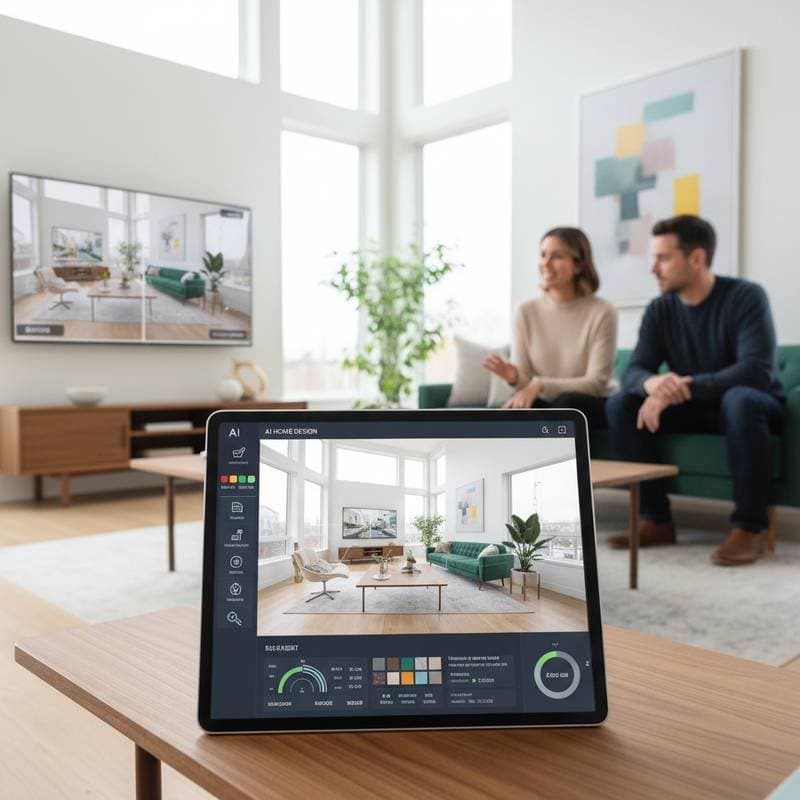
AI Tools That Streamline Home Redesign Planning
Envision the thrill of picturing an ideal living room or a kitchen aligned with daily routines. Excitement surges quickly, yet challenges soon emerge. Considerations such as color schemes, spatial arrangements, furniture proportions, illumination, and financial constraints often lead to disarray and hesitation. Artificial intelligence addresses these issues effectively. Tasks that previously demanded extensive preparation, manual drawings, and repeated revisions now proceed with precision and assurance, courtesy of innovative AI design platforms that deliver insights akin to those from a seasoned professional.
Essential Benefits
- AI-driven platforms enhance visualization of spaces and informed layout choices.
- Users experiment with diverse aesthetics without committing to physical alterations or expensive errors.
- Integrated budget calculators and intelligent scheduling maintain fiscal practicality.
- Compatibility with augmented reality and virtual reality facilitates pre-implementation project reviews.
- Emphasis on sustainability guides creation of environmentally responsible environments.
Precision Where Vision and Simulation Converge
Picture assessing whether a rich green accent wall enhances coziness in the living room or merely reduces brightness. Conventional applications display color samples, yet AI platforms simulate daylight progression across surfaces. These systems assess current decor and propose harmonious shades aligned with individual preferences. Solutions like Planner 5D, RoomGPT, and Homestyler employ sophisticated algorithms to interpret uploaded images and produce lifelike redesigns, accounting for proportions and illumination seamlessly.
The appeal resides in the intuitive support for choices. Individuals upload images, articulate desired themes, and observe regenerated configurations emerge promptly. This process resembles swift manifestation of concepts rather than mere computation. For those bridging conceptual inspirations to tangible spaces, such tools provide an ideal connection.
Enhancing Creativity Through Data and Customization
AI platforms for home redesign augment rather than supplant imagination. Several systems adapt to user inclinations progressively. For instance, repeated selections of mid-century pieces and warm timber prompt suggestions for matching fabrics and lighting. Certain applications consult inventory sources to propose items within specified budgets, including procurement pathways.
Financial clarity ranks among the primary stressors in redesign endeavors. Contemporary AI solutions incorporate adaptive expense projections influenced by choices in materials, area dimensions, and regional labor rates. Switching from laminate to quartz surfaces reveals immediate impacts on overall expenditures. This capability not only conserves resources but also averts irritation from unforeseen costs during implementation.
Cost Breakdown Examples
- Platform subscriptions: Range from free access to $25 monthly for advanced features.
- Virtual consultation sessions: Typically $50 to $200 each.
- Estimation tools for materials: Integrated in professional tiers.
- Augmented reality accessories: Supplementary devices priced $100 to $300.
Variations occur by location, but these figures offer reliable expectations. Relative to engaging comprehensive design services, AI-supported approaches remain economical while furnishing dependable aesthetic and functional direction.
Structured Digital Planning Process
Contemporary AI environments excel through their methodical frameworks. Rather than confronting empty interfaces, participants navigate sequences reflective of professional methodologies.
- Document existing conditions: Submit photographs or precise measurements.
- Outline objectives: Specify renovation, minor updates, or comprehensive overhauls.
- Identify stylistic directions: Options include minimalist, rustic, contemporary, or varied.
- Generate visualizations: Examine numerous configurations immediately.
- Modify elements: Exchange surfaces, reposition partitions, or evaluate illumination shifts.
- Project expenses and timelines: Analyze comprehensive summaries prior to advancement.
- Distribute outputs: Produce plans suitable for specialists or personal application.
This progression converts uncertainty into organized strategies. It diminishes reliance on tangible trials or avoidable disruptions. Every concept undergoes virtual scrutiny before any physical modification.
Embedding Sustainability in Design Choices
Increasing numbers of residents emphasize ecological considerations, and AI platforms support this trend discreetly. By evaluating material durability and efficiency metrics, select systems advocate for resilient flooring, non-toxic coatings, or repurposed elements compatible with chosen themes. Additional computations project reductions in energy use from enhanced lighting or barrier upgrades.
Such incorporation extends beyond ethics to enduring value. Efficient selections frequently lower ongoing expenses and elevate asset worth. AI interfaces illustrate ecological and economic advantages, simplifying validation of initially pricier green options.
Resolving Potential Issues Proactively
Seasoned self-directed renovators recognize the dismay of mismatched hues post-application or disproportionate furnishings. AI simulations curtail such disappointments. Digital placement tools position items at accurate scales within modeled areas. Rotations, relocations, and pathway assessments confirm usability and equilibrium.
For self-managed portions, AI identifies risks automatically. In kitchen configurations, platforms detect regulatory distances near devices and notify of insufficient gaps. These safeguards promote security and adherence absent specialized expertise.
Collaborating with Experts on Advanced Endeavors
DIY participants achieve impressive results under AI direction, yet intricate modifications occasionally necessitate specialist involvement. Numerous platforms feature shared workspaces enabling remote participation by architects or builders. Professionals examine proposals, propose substitutes, and integrate with construction applications for fluid progression from idea to realization.
Structural modifications or wiring adjustments demand licensed oversight prior to initiation. AI bolsters innovation and precision, though critical safety tasks require qualified execution.
Evolving Partnership Beyond Initial Planning
Post-planning, AI systems continue to adapt. Several provide upkeep logs and periodic refresh notifications. Increased summer illumination in living areas might prompt recommendations for airy textiles or shading solutions to regulate climate. Alerts for replenishing used supplies aid sustained care.
Extended interaction refines system comprehension of routines. Eventually, predictions emerge for repainting needs, local eco-furnishing sources, or adaptations to family shifts. This evolves isolated efforts into dynamic alliances attuned to changing needs.
Practical Strategies for Optimal Results
- Begin modestly: Test one area prior to broader scopes.
- Provide exact specifications: Accurate data improves output quality.
- Capture midday lighting: Daylight images ensure precise hue evaluations.
- Confirm local stock: Suggestions may draw from global sources; check availability nearby.
- Prioritize precautions: Professional review essential for foundational or wiring alterations.
Adopting these practices fosters efficient journeys and dependable achievements.
Executing Your Vision with Confidence
Artificial intelligence refines the journey from concept to completion without diminishing human ingenuity. By combining analytical rigor with empirical precision, these platforms convert daunting redesigns into directed explorations rich in rewards.