
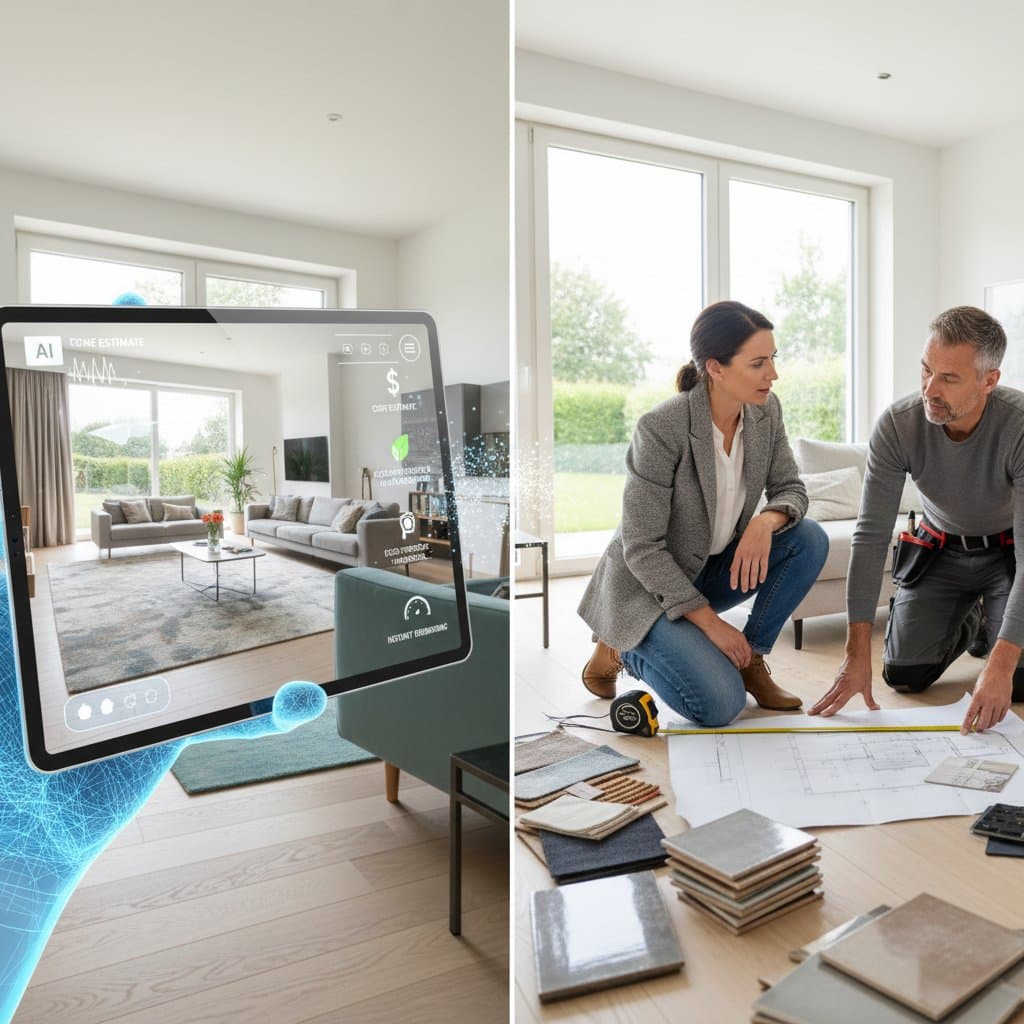
AI Versus Professionals: Transforming Home Design Decisions
Homeowners often face overwhelming choices during renovations, such as selecting paint colors or arranging furniture layouts. These decisions influence budgets, timelines, and overall satisfaction. Artificial intelligence now assists by providing rapid, data-driven options that enhance traditional approaches. The core inquiry remains: Does AI supplant the expertise of professional designers and contractors, or does it serve as a complementary resource in the renovation process?
Emerging Innovations in Home Design
AI-powered platforms have gained widespread adoption by delivering virtual room visualizations and immediate cost projections. Users upload images of their spaces, specify style preferences, and receive complete digital redesigns in moments. These systems frequently link to e-commerce sites for furniture suggestions, material pricing, and sustainability recommendations.
Tools such as RoomGPT and Planner 5D enable experimentation with color combinations, furniture placements, and surface finishes without physical alterations. This method offers immediate results, eliminates trial-and-error waste, and avoids high consultation expenses. Homeowners appreciate the accessibility for initial planning stages.
Strengths of AI in Design Applications
AI excels at handling visual analysis and producing swift variations. It evaluates factors like illumination patterns, traffic flow, and proportional balance instantaneously. In compact areas, AI generates configurations that optimize usable space effectively.
It proposes appropriately scaled furnishings to prevent overcrowding and curates palettes that amplify daylight. Budget clarity stands out as a key benefit. Integration with vendor databases provides current prices for supplies and items, allowing comparisons that reveal financial impacts. This transparency proves invaluable for constrained renovation funds.
Sustainability features further enhance AI utility. Platforms evaluate thermal performance, fixture efficiency, and equipment ratings. By reviewing a homes current setup, AI identifies modifications that lower ongoing energy expenses. For example, recommending specific LED fixtures or shading solutions can yield substantial savings annually.
Limitations of AI in Personalized Design
AI advances rapidly, yet it encounters boundaries in capturing human elements. It processes data patterns but overlooks emotional attachments, family dynamics, or individual aesthetics that professionals discern intuitively. An algorithm cannot account for preserving heirloom pieces or accommodating childrens play habits, which define a spaces character.
Outputs often reflect prevailing styles from aggregated data, risking uniform aesthetics over bespoke solutions. Results may appear modern yet fail to convey intended coziness or uniqueness. Moreover, cost forecasts overlook practical hurdles. Experts anticipate issues like hidden utilities or foundation irregularities during alterations, whereas AI projections remain theoretical.
Expertise Offered by Professionals
Designers and contractors provide irreplaceable depth through sensory and experiential judgment. They assess daily light variations, material tactility, and integration with existing infrastructure. Knowledge of regulations, secure practices, and utility navigations ensures compliant outcomes.
Professionals act as strategic guides, offering confidence amid indecision and adjusting plans dynamically. They blend premium and economical elements to maximize value while upholding visual harmony. Contractors oversee vendor networks for cost reductions, synchronized logistics, and schedule adherence, minimizing disruptions.
Integrating AI and Professional Input
A balanced strategy leverages AI for ideation and experts for implementation. Employ AI to generate concepts, evaluate hues, or assemble visual references. Present these to professionals for tailoring, streamlining discussions and clarifying objectives.
Consider a scenario where AI illustrates open cabinetry in a kitchen. A designer evaluates usability, perhaps advocating enclosed lower sections for households with active children or frequent meal preparation. This collaboration merges technological efficiency with contextual wisdom.
Evaluating Financial Implications
Professional services vary: consultations start at several hundred dollars, while comprehensive packages reach thousands based on scope. Contractor fees encompass labor and materials, fluctuating by project scale. AI subscriptions or single uses typically cost twenty to several hundred dollars, scaling with features.
AI appears economical initially, yet major overhauls benefit from expert oversight to avert expensive corrections. Professionals detect flaws early, safeguard durability, and allocate resources toward enduring quality. For minor updates like refreshes or rearrangements, AI suffices affordably. Structural endeavors demand specialist involvement for reliability.
Prioritizing Safety and Compliance
Professionals emphasize security, addressing load-bearing elements and local standards that AI cannot interpret. Verify any AI-proposed modifications to wiring, piping, or frameworks with certified experts. Even basic enhancements, such as installing overhead lights or widening passages, carry risks without proper execution.
Incorporating Emotional Depth in Design
Homes foster connections and self-expression beyond functional layouts. AI aids visualization but neglects narrative layers. Designers interpret personal stories to infuse authenticity, selecting elements that resonate with lifestyle rhythms.
AI might propose sleek neutrals from data trends, but a professional could advocate earthier shades upon learning of preferences for intimate gatherings. This insight elevates designs from attractive to meaningful.
Practical Strategies for Effective Use
When adopting AI tools, follow these steps:
- Begin modestly by testing a single area to gauge alignment with your tastes.
- View AI outputs as starting points rather than definitive blueprints.
- Consult licensed specialists for any technical or infrastructural advice.
- Plan finances conservatively, incorporating buffers for unforeseen expenses.
- Layer AI suggestions with personal elements like custom artwork or legacy items.
This integrated method harnesses analytical strengths alongside creative insight.
Sustaining Your Home Design Over Time
Post-completion, observe how selections influence routines. Whether AI informed fixture arrangements or professionals ensured ergonomic flow, the aim centers on intuitive, tailored environments. Retain digital models for ongoing tweaks, such as decor rotations or efficiency upgrades.
Homes evolve with needs. AI facilitates foresight, while experts enable realization, crafting enduring narratives.