
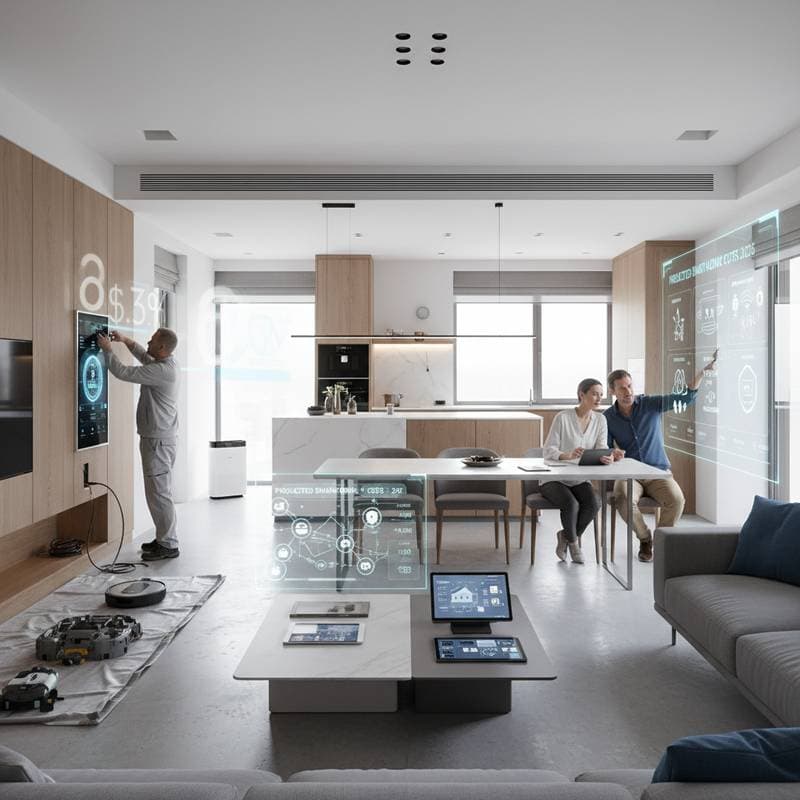
The True Costs of Integrating Smart Home Technology in 2026 Remodels
Imagine entering a remodeled home where lights dim automatically to match the evening mood, the thermostat maintains ideal comfort without manual adjustments, and blinds rise with the morning sun. Such experiences highlight the appeal of smart home technology. However, the path to this convenience involves devices, software integrations, installation expenses, and maintenance fees that often surprise homeowners.
Planning a complete renovation or targeted upgrades requires a clear grasp of these costs to maintain budget control and prevent disruptions. This guide details expected expenses for smart technology in remodels, contrasts DIY and professional installation options, and evaluates upgrades for optimal long-term value. It also provides practical troubleshooting advice and frameworks to select automation levels suited to individual needs and finances.
Typical Smart Home Budget Ranges
The following table summarizes key cost categories and price ranges for remodel projects incorporating smart technology.
| Smart Upgrade Type | Typical Cost Range | Installation Type | Ongoing Costs | Average ROI |
|---|---|---|---|---|
| Smart Lighting | $800 - $3,500 per room | DIY or Professional | Optional app subscriptions | Moderate |
| Smart Thermostats | $200 - $800 per unit | DIY or Professional | Minimal | High |
| Smart Security Systems | $1,000 - $7,500 | Professional preferred | Monthly monitoring ($15-$50) | High |
| Smart Appliances | $1,500 - $15,000 | Professional | Occasional software updates | Moderate |
| Smart Blinds and Shades | $300 - $1,000 per window | Professional | Minimal | Moderate |
| Whole-Home Automation Hubs | $5,000 - $25,000+ | Professional | Cloud or maintenance fees | High |
These estimates reflect mid-range products in average-sized homes. Expenses rise for premium brands or properties with intricate layouts, such as multi-story designs or older wiring.
Detailed Cost Breakdown by Category
Smart Lighting Systems
Smart lighting enhances routines and reduces energy use. Options range from retrofitting current fixtures with bulbs to installing dedicated switches or panels.
- Bulb-based systems: Prices range from $20 to $50 per bulb, making them suitable for temporary setups or rental properties.
- Switch-based systems: Expect $150 to $500 per switch, including labor, for durable, whole-home solutions.
- Panel-based systems: Full-room setups with dimmers and sensors cost $2,000 to $10,000.
Professionals handle wiring to avoid overloads and ensure code compliance. Individuals with electrical knowledge can opt for DIY using plug-and-play kits, but testing circuits beforehand prevents hazards.
Smart Thermostats and HVAC Controls
These devices offer strong value through energy optimization. Prices span $200 to $800 based on capabilities like location-based adjustments or multi-room zoning.
Installation for single-zone systems requires about one hour and basic tools. Complex HVAC setups demand expert intervention to integrate sensors properly. Many users recover investments in under a year via reduced utility bills, often 10-20% savings on heating and cooling.
Smart Security and Surveillance
Advancements in this area provide robust protection. Entry-level kits with cameras and sensors start at $1,000, while comprehensive systems including locks, alarms, and app access reach $7,500 or more.
Professionals calibrate equipment for optimal coverage and secure network connections. Monthly monitoring services, essential for alerts and response, cost $15 to $50. Evaluate coverage needs, such as indoor-outdoor integration, to avoid under- or over-investing.
Smart Appliances
Connected refrigerators, washers, and ovens streamline tasks with features like inventory tracking or remote operation. Budget $1,500 to $15,000 per appliance, varying by model and smart features.
Verify electrical capacity before purchase, as high-power units may require panel upgrades costing $500 to $2,000. Prioritize appliances with open protocols to ensure future compatibility across brands.
Smart Window Treatments
Automated shades improve privacy, light control, and insulation. Battery-operated units begin at $300 per window; wired or bespoke options exceed $1,000.
Experts install to align with tracks and link to automation hubs. Pairing with sensors for sunlight response maximizes efficiency, potentially cutting cooling costs by 15% in sunny climates.
Whole-Home Automation Systems
These platforms unify lighting, climate, audio, and security for centralized management. Investments range from $5,000 to $25,000, scaling with home square footage and device count.
Extensive wiring and programming necessitate certified installers. Select scalable systems supporting protocols like Zigbee or Z-Wave to accommodate future expansions without full overhauls.
Safety and Security Considerations
Connectivity powers smart homes but exposes them to risks. Implement these measures to safeguard systems:
- Secure Wi-Fi with WPA3 encryption and distinct passwords for guest access.
- Schedule automatic firmware updates to address vulnerabilities.
- Isolate smart devices on a dedicated subnet to protect sensitive data.
- Review and restrict app permissions to essential functions only.
- Engage certified electricians for all power modifications.
Neglecting these practices risks malfunctions or cyber threats. Prioritize robust setups to enjoy benefits without compromise.
Troubleshooting Common Issues
Reliable systems occasionally falter. Quick resolutions minimize downtime.
Connectivity Drops
- Cause: Insufficient signal or network overload.
- Solution: Deploy mesh networks for broader coverage or prioritize traffic via router settings.
Device Incompatibility
- Cause: Diverse protocols across products.
- Solution: Adopt a unified platform or Matter-standard hubs for seamless bridging.
Voice Command Failures
- Cause: Echo issues or duplicate labels.
- Solution: Assign clear, unique names and reposition microphones for better capture.
Delayed Automation Triggers
- Cause: Remote server delays or legacy software.
- Solution: Enable on-device processing and perform routine updates.
Battery Drain in Wireless Devices
- Cause: Overactive sensors or distance from hubs.
- Solution: Calibrate trigger thresholds and consider hardwired alternatives for high-use areas.
Planning Your Smart Home Upgrade
Assess your priorities, such as energy savings or security, to guide selections. Start small with high-ROI items like thermostats, then scale to integrated systems. Consult local experts for site-specific advice, ensuring your remodel delivers lasting efficiency, comfort, and property value.