
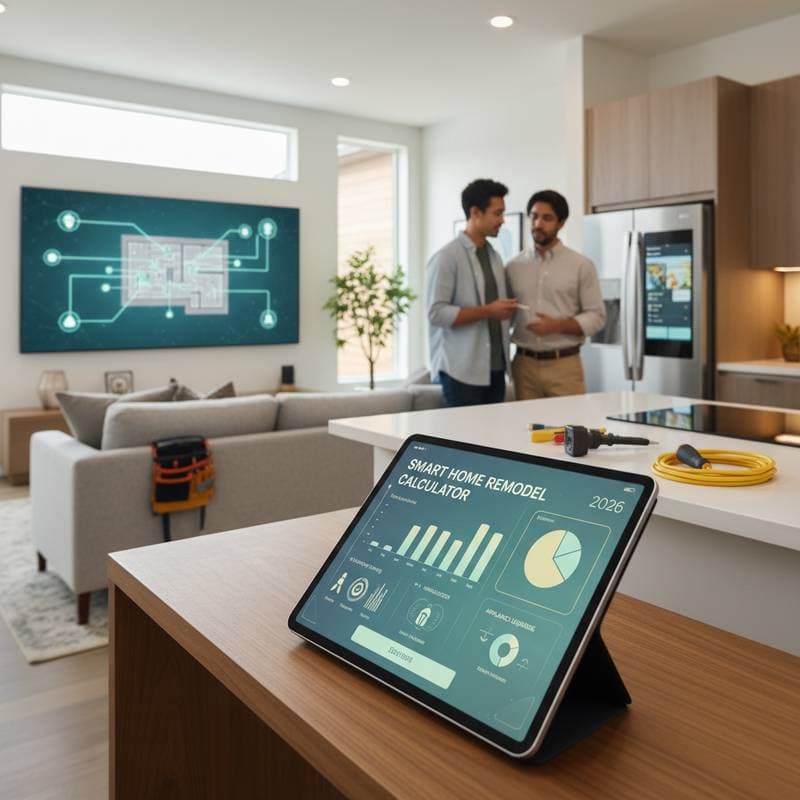
Smart Home Remodel Calculator: Plan Your 2026 Budget
When you picture the perfect home, it probably involves comfort, convenience, and control. Smart home technology brings all three together. It transforms ordinary spaces into connected environments that anticipate your needs. Yet one big question stops many homeowners from moving forward. How much does a smart home remodel actually cost?
The answer depends on your goals, your home starting point, and how deeply you want to integrate automation. Our Smart Home Remodel Calculator breaks down costs by category. It helps you balance investment, efficiency, and lifestyle upgrades.
Key Cost Categories and Typical Ranges
A smart home remodel includes many interconnected parts. The table below shows the primary categories our calculator uses along with realistic budget expectations.
| System | Basic Range | Advanced Range | Typical ROI Potential |
|---|---|---|---|
| Lighting Automation | $500 - $2,500 | $3,000 - $10,000 | Moderate energy savings, improved ambiance |
| Smart Thermostat & HVAC | $400 - $2,000 | $3,000 - $8,000 | High savings on energy bills |
| Security & Access | $600 - $3,000 | $4,000 - $12,000 | Strong resale value, peace of mind |
| Smart Kitchen | $1,500 - $6,000 | $8,000 - $20,000 | Convenience and long-term efficiency |
| Entertainment & Audio | $800 - $4,000 | $5,000 - $15,000 | Lifestyle enhancement, moderate ROI |
| Home Network Infrastructure | $1,000 - $5,000 | $6,000 - $15,000 | Essential for system reliability |
| Whole-Home Integration | $2,000 - $10,000 | $12,000 - $30,000 | High resale appeal, seamless control |
These ranges reflect both DIY-friendly and professionally installed systems. Regional labor costs and the age of your home wiring can shift these numbers. Use the calculator to fine-tune based on your zip code.
DIY vs. Professional Installation
Many smart home products support DIY setup. Not all systems prove equally simple. Understanding where to draw the line saves time, frustration, and potential safety issues.
DIY-Friendly Upgrades
- Smart bulbs and plugs
- Video doorbells and basic security cameras
- App-controlled thermostats
- Voice assistants and smart speakers
These options install with minimal tools. They often connect directly to your Wi-Fi network.
Professional-Recommended Projects
- Whole-home wiring or rewiring
- Integrated HVAC automation
- Security systems connected to emergency services
- Centralized hubs controlling multiple protocols
Professional installers ensure compatibility, code compliance, and secure data integration. Labor costs typically add 15 to 25 percent to your total budget. The peace of mind often justifies the expense.
Common Budget Pitfalls and How to Avoid Them
Smart home projects sometimes exceed budget due to overlooked details. Here are the most common traps.
- Underestimating network demands. Many devices rely on strong Wi-Fi coverage. Weak signals cause lag or disconnections. Invest in a mesh network or professional-grade router early.
- Mixing incompatible systems. Not all smart devices communicate smoothly. Stick to one ecosystem when possible to simplify control.
- Ignoring future expansion. Plan for growth by choosing scalable systems with open standards. This approach keeps future upgrades affordable.
- Forgetting maintenance costs. Some smart devices require subscription services for full functionality. Factor these expenses into your long-term budget.
Planning Your Smart Home Timeline
A small smart home upgrade finishes in a weekend. A full remodel may require several weeks. Here is a general breakdown.
- Assessment and Planning: 1 to 2 days
- Purchasing and Preparation: 3 to 5 days
- Installation: 2 to 10 days depending on complexity
- Testing and1 to 3 days
Our calculator includes a time estimator. You can align the project with your schedule.
Finalize Your Upgrade Strategy
Smart home remodeling blends technology, design, and practicality. The Smart Home Remodel Calculator provides a structured way to predict costs, prioritize features, and plan each phase. Review which rooms benefit most from automation. Set a realistic budget range. Compare DIY and professional options. Build in a small contingency for network upgrades or wiring challenges. Once complete, your home responds to your voice or smartphone. It adapts to your habits, saves energy, and improves comfort daily.