
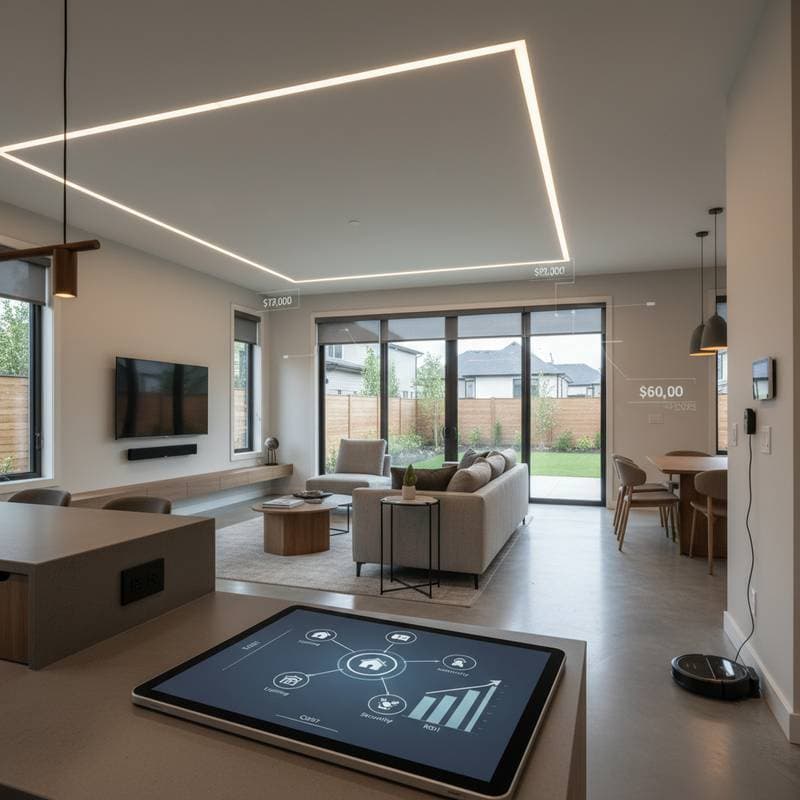
Security Systems
Professional monitoring services or cloud storage subscriptions typically cost between $10 and $40 each month, depending on the provider. Systems designed for do-it-yourself installation provide cost savings, yet they demand greater technical knowledge for initial setup and subsequent troubleshooting.
4. Smart Entertainment and Media Control
Home entertainment automation unifies speakers, screens, and streaming services into a single system. Expenses vary significantly according to quality levels and project scope.
- Basic smart speakers and streaming hubs: $200 to $600
- Whole-home audio systems: $3,000 to $10,000
- Integrated home theater automation: $8,000 to $25,000
These setups frequently require expert calibration to achieve optimal sound distribution and reliable device connectivity. Homeowners who host gatherings often or prefer streamlined, cable-free environments appreciate the ability to manage music, films, and lighting through one application.
5. Whole-Home Automation Platforms
To coordinate functions such as blinds and door locks seamlessly, a central hub or unified control system becomes essential. Pricing for these platforms fluctuates based on their intricacy.
Typical price ranges:
- Entry-level do-it-yourself hubs: $300 to $800
- Professionally installed systems: $5,000 to $25,000 or higher
- Advanced custom integrations: $30,000 and above
Expert integration guarantees that lighting, security, and climate controls interact smoothly across devices, reducing delays and compatibility challenges.
DIY vs. Professional Installation
Determining the right moment to engage professionals helps avoid unnecessary expenses and aggravation.
DIY-Friendly Systems
- Smart bulbs, plugs, and thermostats
- Plug-and-play security cameras
- Voice assistants and smart speakers
Do-it-yourself initiatives can reduce labor expenses by 20 to 40 percent. Such projects necessitate patience and basic technical proficiency. The primary difficulty involves confirming that all devices operate on the identical network and execute app instructions accurately.
Professional Installations
- Whole-home audio or lighting networks
- Integrated security systems
- Custom automation hubs
Professional services generally charge $75 to $150 per hour, with comprehensive smart home configurations requiring 20 to 60 hours of work. Reliability stands as the key benefit. Specialists manage wiring, network enhancements, and programming to eliminate conflicts among various brands or platforms.
Decision Framework:
- Engage a licensed installer for any project that includes wiring or electrical modifications.
- Consult a network expert if Wi-Fi coverage proves inconsistent throughout the home.
- Opt for scalable platforms from the outset if expansion plans exist, allowing professionals to perform updates in the future.
Troubleshooting Common Smart Home Problems
Well-designed systems occasionally encounter disruptions. The following outlines frequent challenges alongside effective resolutions.
1. Connectivity Failures
Wi-Fi overcrowding or feeble signals often trigger these problems. Install a mesh network or Wi-Fi extender, and designate distinct network identifiers to avoid device mix-ups.
2. Inconsistent Voice Commands
Devices that disregard instructions may stem from incomplete ecosystem linkages. Reconnect them via the primary application and confirm that firmware remains current.
3. Power or Battery Issues
Numerous smart devices depend on compact batteries that drain more rapidly than anticipated. Maintain a supply of replacements and conduct quarterly inspections for timely changes.
4. Integration Conflicts
Certain products lack full interoperability across manufacturers. Prior to acquisition, confirm compatibility with selected platforms like Alexa, Google Home, or Apple HomeKit.
5. Over-Automation
Excessive triggers might result in disarray, such as lights deactivating during use. Initiate with basic automations and gradually incorporate additional ones as personal routines become clear.
Smart Home Cost Comparison Table
| Category | Average DIY Cost | Professional Cost | Typical ROI | Maintenance |
|---|---|---|---|---|
| Lighting | $150 - $1,000 | $1,500 - $6,000 | High | Low |
| Climate Control | $150 - $500 | $1,500 - $3,000 | High | Low |
| Security | $250 - $1,000 | $2,500 - $6,000 | Medium | Moderate |
| Entertainment | $200 - $2,000 | $8,000 - $25,000 | Medium | Moderate |
| Whole-Home Automation | $300 - $1,000 | $5,000 - $25,000+ | High | Moderate |
Timing and Seasonal Considerations
Align smart home installations with broader renovation efforts for optimal results. During painting, flooring replacement, or fixture upgrades, incorporate wiring or additional outlets to accommodate future automation needs.
For exterior components like cameras or irrigation controllers, select temperate conditions to minimize exposure to dampness during assembly. Numerous residents time thermostat and insulation enhancements ahead of intense heating or cooling periods to realize immediate energy reductions.
Implementing Your Smart Home Upgrade
Smart home enhancements focus on establishing routines that conserve time, energy, and effort daily. Identify priorities aligned with daily habits, whether that involves adjusting lights from the bedroom, monitoring package arrivals, or sustaining ideal temperatures without manual intervention.
Progress incrementally, evaluate functionality at each stage, and select platforms backed by robust support networks. Factor in comprehensive budgeting that accounts for setup, ongoing fees, and upkeep expenses. Ultimately, these investments yield returns through heightened efficiency, enhanced comfort, and greater tranquility.
The most effective smart homes rely on deliberate design, dependable foundations, and mechanisms that subtly simplify existence.