
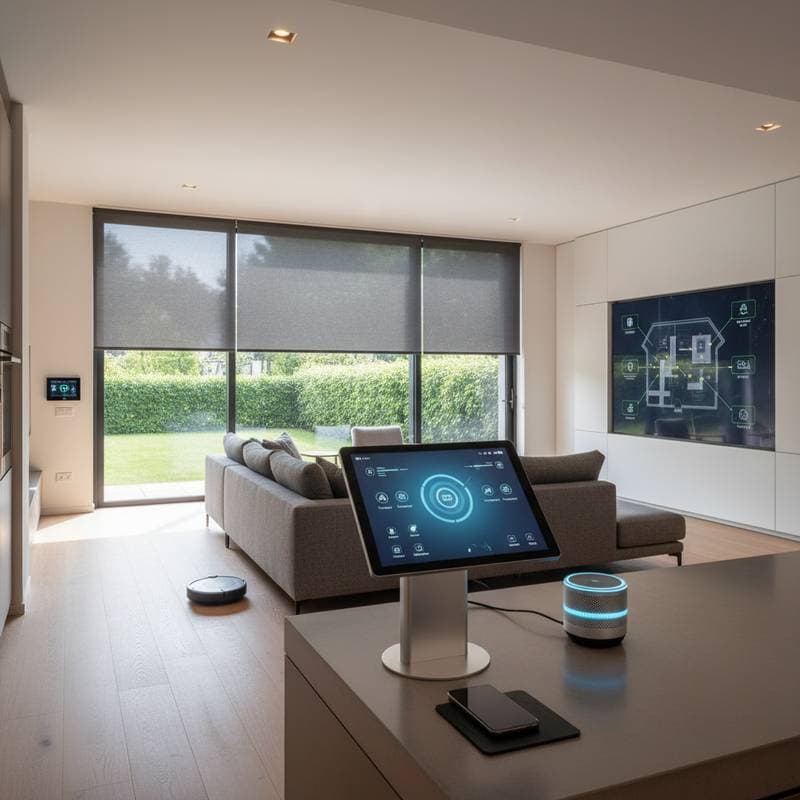
2026 Smart Home Costs: Upgrade Budget Secrets
Home automation captures the imagination of many homeowners. Devices respond to voice commands, adjust environments seamlessly, and enhance security without effort. However, the financial aspect often presents uncertainty. This guide details costs for smart home upgrades ranging from $3,000 to $25,000, highlights valuable investments, and provides strategies to optimize spending while achieving a connected living space.
Benefits of Smart Home Integration
A smart home system creates an environment that anticipates needs and promotes efficiency. Lights activate upon entry, temperatures maintain ideal levels based on occupancy, and alerts notify of potential issues. These features extend beyond convenience to deliver tangible advantages in energy conservation and safety.
Energy savings represent a primary benefit. Automated systems monitor usage patterns and optimize operations, which leads to reduced utility bills. Security enhancements, such as remote monitoring and automated locks, deter intrusions and provide peace of mind. In the real estate market, properties equipped with these technologies often attract buyers willing to pay a premium, with resale values increasing by 5 to 10 percent in competitive areas.
Essential Components and Their Pricing
Smart home setups build around core components that integrate through a central hub. Prices vary based on brand, features, and installation requirements. Understanding these elements helps in selecting options that align with specific budgets.
A basic hub, such as one compatible with voice assistants, costs between $100 and $300. Smart thermostats range from $200 to $400, offering programmable schedules and remote access. Lighting kits, including bulbs and switches, start at $50 per fixture and scale up with multi-room systems. Security cameras and sensors add $150 to $500 per unit, while connected locks fall between $200 and $350.
Appliances like smart refrigerators or washers integrate at higher costs, from $1,000 to $3,000 each. Full ecosystems from providers like Google or Amazon ensure compatibility but require investment in proprietary devices. Professional installation adds 20 to 50 percent to hardware expenses, depending on complexity.
Budget Breakdown: From $3,000 Starter to $25,000 Premium
Tailor upgrades to financial constraints by focusing on high-impact areas first. This section outlines realistic plans for different spending levels, including hardware, installation, and potential savings.
$3,000 Budget: Essential Foundations
At this entry level, prioritize core functionality in high-traffic areas. Allocate $500 to a central hub and voice control system. Invest $800 in a smart thermostat and basic lighting for the living room and kitchen, which includes four to six bulbs and switches.
Dedicate $1,000 to security essentials: two cameras, door sensors, and a smart lock. The remaining $700 covers wiring, basic installation, or minor customizations. This setup yields immediate energy savings of 15 to 20 percent on heating and lighting, with security features preventing common household risks.
$5,000 to $10,000 Budget: Expanded Comfort and Control
Build on basics with broader coverage. Spend $1,500 on an advanced hub that supports multiple protocols like Matter for future-proofing. Add $2,000 for thermostats in multiple zones and automated blinds or shades in bedrooms and living areas.
Security expands to $2,500 with indoor and outdoor cameras, motion detectors, and a doorbell camera. Include $1,000 for smart plugs and appliances, such as a connected coffee maker or vacuum. Installation costs $1,000 to $2,000 for professional setup. Expect 25 percent reductions in energy costs and enhanced daily automation that saves hours weekly.
$15,000 to $25,000 Budget: Full-System Automation
Comprehensive upgrades transform the entire home. A robust hub and network infrastructure cost $2,000 to $3,000, ensuring seamless connectivity across all devices. Climate control for the whole house, including multi-zone HVAC integration, runs $4,000 to $6,000.
Lighting and shading systems for every room total $5,000, with customizable scenes and energy monitoring. Security becomes enterprise-level at $5,000 to $7,000, featuring 24/7 monitoring, advanced sensors, and integration with local authorities. Appliances and entertainment systems add $3,000 to $5,000. Professional design and installation consume $3,000 to $5,000. This investment recoups through 30 to 40 percent energy savings and a potential 10 percent boost in property value.
Overlooked Expenses and Mitigation Strategies
Beyond initial purchases, recurring costs influence long-term affordability. Subscription services for cloud storage and advanced security features range from $10 to $50 monthly. Firmware updates occasionally require new hardware, budgeted at $200 to $500 every three to five years.
Compatibility challenges arise with mismatched devices, leading to additional adapters or replacements costing $100 to $1,000. Electricity for always-on devices adds $50 to $200 annually if not managed. To mitigate, select unified ecosystems and open standards. Conduct compatibility checks via manufacturer apps before purchase. Opt for energy-efficient models certified by Energy Star to minimize ongoing bills.
Strategies for High Return on Investment
Target upgrades that deliver both convenience and financial benefits. Smart thermostats recover costs within one to two years through 10 to 23 percent savings on HVAC expenses. Intelligent lighting systems cut electricity use by 50 to 75 percent, especially in homes with frequent lighting changes.
Water leak detectors, priced at $50 to $150 each, avert damages averaging $5,000 per incident. Integrated security reduces insurance premiums by 5 to 15 percent in many regions. Prioritize these in planning to achieve 60 to 80 percent ROI over five years. Consult local incentives, such as rebates for energy-efficient tech, to further offset expenses.
Maintaining and Evolving Your Smart System
Routine upkeep ensures reliability and security. Update software quarterly through dedicated apps to patch vulnerabilities. Replace batteries in sensors every six to twelve months and inspect wiring annually.
Monitor performance via dashboards to identify inefficiencies, such as underused devices. As technology advances, integrate new components gradually to avoid obsolescence. This approach sustains benefits, from effortless daily routines to substantial savings over time.
Achieving Effortless Efficiency
Smart home upgrades elevate living standards through thoughtful investment. Select components that align with lifestyle needs and budget limits. The result is a residence that operates intuitively, conserves resources, and enhances security. Plan strategically to realize these advantages without excess expenditure.