
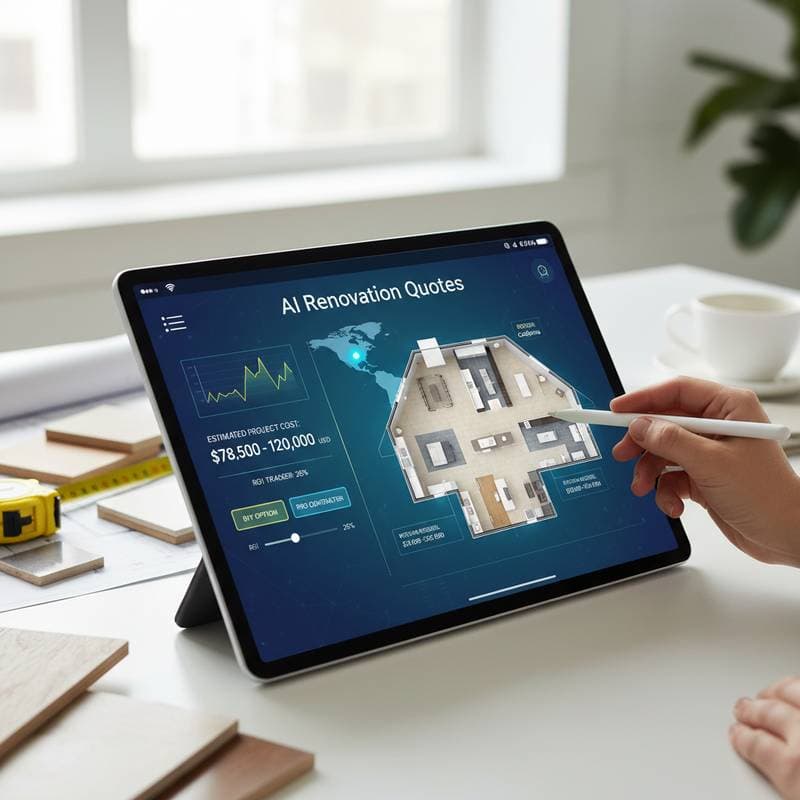
AI Instant Quotes Transform Remodeling Budgeting
Homeowners often face prolonged delays when seeking remodeling estimates from contractors. These waits create uncertainty about project costs, hindering planning and dampening excitement for potential updates. AI-driven instant quote tools now provide detailed, location-specific estimates in seconds, enabling informed decisions and efficient budgeting.
These systems leverage vast datasets from completed projects and real-time market data to deliver accurate pricing. Users input project specifics, such as room dimensions and material preferences, to receive breakdowns that account for local labor rates and material availability. This approach empowers individuals to compare options, assess feasibility, and proceed with confidence.
Challenges of Conventional Estimating Processes
Traditional methods present several obstacles for homeowners. Estimates frequently require weeks due to contractors' busy schedules. Pricing varies significantly between providers for identical work, complicating comparisons.
Moreover, many quotes lack detailed itemization, obscuring expense allocations. These factors complicate budget alignment with design aspirations. AI estimators offer a reliable baseline, revealing within minutes if a bathroom refresh costs approximately two thousand dollars or approaches twelve thousand dollars.
Mechanics of AI-Powered Quote Generation
AI tools employ pattern recognition, predictive algorithms, and localized databases to produce precise cost projections. Users enter details like square footage, selected materials, and finish levels; the system then matches these against extensive project histories.
Key processes include data aggregation from supply networks, labor market analyses, and regulatory standards. Machine learning refines comparisons to yield tailored ranges. Outputs appear instantly, detailing materials, labor, permits, and potential add-ons.
Advanced features incorporate seasonal variations, advising on optimal timing for cost savings. This comprehensive view supports strategic planning beyond mere numerical totals.
Reliable Cost Projections for Common Upgrades
AI provides transparent, adjustable estimates that eliminate ambiguity. For instance, kitchen cabinetry installation ranges from four thousand five hundred dollars to seven thousand eight hundred dollars based on material selections.
Countertop options vary: quartz installations cost two thousand dollars to five thousand five hundred dollars, while laminate versions fall lower. Plumbing modifications span one thousand two hundred dollars to two thousand eight hundred dollars. Electrical and lighting updates typically range from eight hundred dollars to one thousand five hundred dollars.
As users adjust variables, such as upgrading from laminate to quartz, totals recalculate immediately. This dynamic functionality serves as a precise budgeting guide.
Evaluating DIY Versus Professional Approaches
AI estimators facilitate decisions between self-managed and expert-led projects. For tile flooring installation, professional rates average ten to fifteen dollars per square foot, compared to three to six dollars per square foot for DIY materials alone.
Such breakdowns highlight trade-offs in time, expertise, and error risks. Homeowners can segment tasks, managing basic elements independently while engaging specialists for intricate components. This strategy fosters effective resource allocation and project viability.
Integrating Safety and Regulatory Guidance
DIY efforts raise concerns about adherence to codes and safety protocols. AI systems identify permit needs or professional requirements, such as for electrical rewiring or plumbing shifts in bathroom remodels.
These alerts mitigate expensive oversights and promote compliance. Beyond pricing, the tools educate users on procedural essentials, streamlining navigation through complexities.
Enhancing Investment Returns Through Early Insights
Accurate early estimates influence design choices to maximize value. Energy-efficient windows, for example, may elevate initial costs but lower utility expenses over time.
AI often projects return on investment: window replacements yield seventy to eighty percent recovery, whereas premium bathroom updates return fifty to sixty percent. These insights guide prioritization of high-impact upgrades.
Accounting for Local Market Variations
Generic calculators overlook geographic disparities, where urban kitchen remodels cost twice as much as rural equivalents. AI incorporates geolocation to adjust for regional labor, material sourcing, and logistics.
In remote areas, suggestions for locally available alternatives maintain budget realism. This precision counters supply disruptions and ensures applicable projections.
Combining Automation with Expert Input
AI manages calculations while preserving personal involvement. Integrated platforms connect users to vetted contractors for aligned bids and consultations.
Side-by-side reviews, feedback evaluations, and direct scheduling enhance trust. Contractors benefit from qualified inquiries, reducing estimation efforts and aligning expectations upfront.
Steps to Utilize AI Estimators Effectively
Begin with modest projects, such as a powder room update or deck enhancement, to familiarize with the interface. Platforms support inputs for dimensions, material tiers from economical to high-end, and extras like enhanced lighting or storage solutions.
Outputs include both self-install and professional variants. Progress to comprehensive plans, incorporating phased costs for financing or contractor discussions.
Pitfalls to Sidestep in Estimations
Precision in data entry proves essential for trustworthy outcomes. Inaccurate measurements inflate or deflate figures.
- Verify dimensions meticulously to avoid discrepancies.
- Specify material choices accurately to prevent mismatched projections.
- Account for overlooked elements like permits through local verification.
- View estimates as foundational references, supplemented by professional quotes.
Strategies for Optimal Results
Revisit estimates periodically to reflect market shifts in supplies or labor. Test layout alternatives, such as open versus enclosed designs, to compare expenses.
Certain tools forecast timelines based on scope and availability. Explore sustainable choices, including energy projections for green upgrades.
Sustaining Remodel Value Over Time
Post-completion, AI maintenance applications schedule tasks like countertop sealing or HVAC servicing. These prevent deterioration and preserve investments.
Periodic re-evaluations track value fluctuations, signaling ideal moments for future work. This ongoing support organizes home management comprehensively.