
Key Points
- Smart home upgrades range from a few hundred dollars for basic automation to tens of thousands for comprehensive whole-home systems.
- Focus on enhancements that provide convenience, safety, and energy efficiency prior to luxury additions.
- Combine self-installed devices with expert-installed components according to project complexity and device compatibility.
- Account for concealed expenses such as wiring, network setups, and ongoing software fees to prevent financial overruns.
When Convenience Meets Craftsmanship
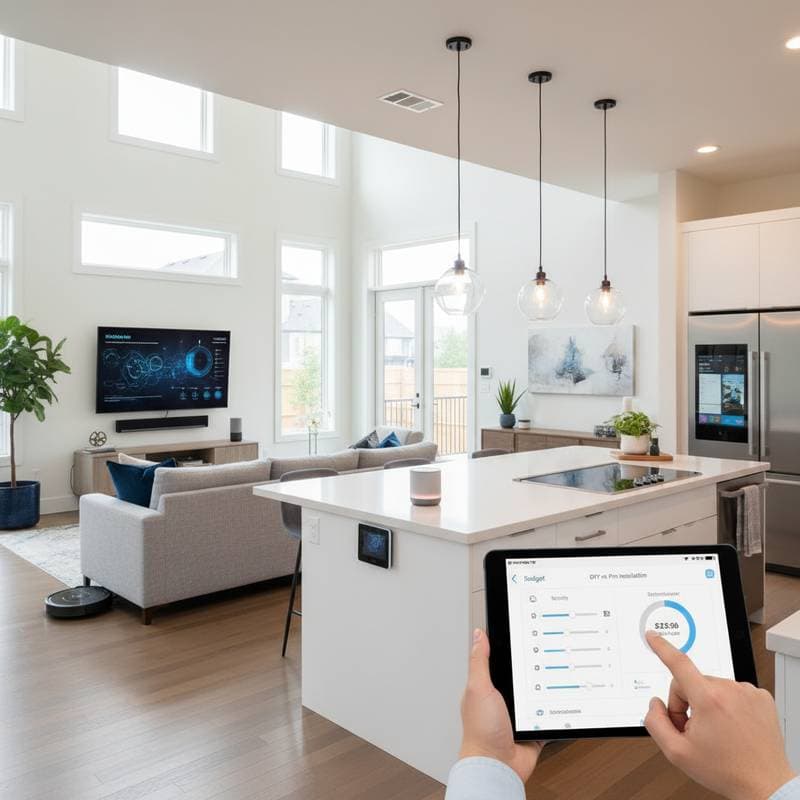
Picture entering a kitchen where lights adjust softly, a preferred music selection plays, and coffee brews automatically. This vision of an integrated home once seemed distant, yet today it lies within reach for many. Each smooth operation depends on interconnected devices, sensors, and software that demand precise planning and financial foresight.
Homeowners frequently launch their smart home efforts with modest aims, such as energy conservation or bolstered security. These initial steps often lead to enthusiasm for broader automation. A deliberate budget transforms isolated tools into a unified network that simplifies routines instead of adding complexity.
Understanding the True Cost of a Smart Home
Expenses for smart home features differ based on automation extent and component quality. An initial configuration for one room begins at $500 to $1,000 and includes items like smart bulbs, outlets, and a voice-activated hub. A moderate setup linking lights, temperature controls, and security falls between $5,000 and $10,000. Complete integration with embedded wiring, multi-room voice commands, and sophisticated energy oversight exceeds $20,000.
Three elements explain these variations: project scope, degree of interconnection, and chosen brand platforms. Self-managed Wi-Fi options prove economical, whereas systems from providers like Control4 or Savant deliver superior cohesion and durability. Determine if the goal involves individual smart items or an interconnected intelligent environment.
Room-by-Room Budget Breakdown
Smart Kitchen Upgrades
Kitchens yield high returns on smart investments. Refrigerators equipped with interior cameras range from $2,500 to $4,000. Linked ovens and dishwashers contribute $1,000 to $2,500 apiece. Modest additions, including outlets for appliances or cabinet lighting responsive to voice, maintain expenses at $200 to $500.
For cost-effective renovations, select energy-saving induction ranges and moisture detectors beneath sinks. These choices enhance usability while averting expensive flood repairs.
Living Room and Entertainment Spaces
Integrated living areas merge relaxation with ease. Voice-enabled televisions commence at $600, with premium versions over $2,000. Incorporate a smart temperature regulator for $150 to $300, plus automated illumination at $200 to $800.
To achieve engaging setups, consider audio networks across rooms from $1,000 onward. Control interfaces or embedded screens add $500 to $1,200.
Bedrooms and Private Spaces
Adjustable shades, responsive lights, and sound-masking tools turn bedrooms into serene areas. Combined costs for these reach $800 to $2,000. Movement detectors and scheduled climate devices promote savings alongside comfort.
An accessible wellness option, such as a bed cover that monitors rest, costs about $300 and introduces health-focused tech.
Security and Outdoor Systems
Protection ranks as the leading smart category. Comprehensive arrays with cameras, entry alerts, and perimeter lights span $400 to $2,000, influenced by capabilities and service plans.
Front-door cameras begin at $100, whereas full-site monitoring with data storage climbs to $3,000. Exterior light controls and watering automation contribute $500 to $1,000, boosting security and resource use.
Hidden Costs That Catch Many Homeowners Off Guard
Smart systems rely on robust connections, making network foundations vital. Router enhancements, mesh networks, or device cabling incur $300 to $1,200.
Ongoing fees for data storage, surveillance, or premium functions range from $10 to $40 monthly. Such charges accumulate over time and warrant upfront consideration.
Expert setup and tuning fees also startle novices. Qualified technicians bill $75 to $150 hourly for intricate cabling or tailored configurations.
Balancing DIY and Professional Help
Certain owners relish assembling components solo, gaining knowledge via experimentation and phased growth. For straightforward elements like outlets, lights, or climate units, this method cuts expenses substantially.
Projects requiring power adjustments, heating linkages, or building alterations necessitate specialist involvement to guarantee safety and effectiveness. Electricians with smart tech expertise ensure seamless device harmony.
A combined strategy proves optimal. Handle basic installations personally, yet engage experts for connectivity planning and overall unification. This method controls spending while securing enduring results.
Sustainable Choices That Pay Off
Well-planned smart homes lessen ecological footprints. Temperature controllers reduce heating and cooling by up to 10 percent. Light automation cuts power consumption by 15 to 20 percent.
Opt for products with reusable parts and firms providing extended updates. Steer clear of short-lived items prone to obsolescence. Select adaptable bases compatible with multiple makers to support future adjustments.
Leak detectors, precise watering, and optimized environments foster eco-friendliness and reduced bills, harmonizing innovation with stewardship.
Planning Your Smart Home Budget
Divide allocations into three areas:
- Foundation: Connectivity bases, cabling, and core controllers.
- Functionality: Temperature, illumination, and protection elements that elevate routines.
- Flair: Media, premium tools, and unique sequences.
Establish the base first, as it underpins stability. Direct 40 percent of funds here. Assign 35 percent to practical improvements for ease and thrift. Reserve 25 percent for style or personal touches.
This framework maintains equilibrium between essentials and pleasures.
Pro Tips for Success
- Map automation areas in advance and rank interconnected priorities.
- Select expandable bases with update capabilities for longevity.
- Fortify connections by updating credentials and applying safeguards.
- Add components incrementally and verify operations prior to growth.
- Record details like identifiers, versions, and guides for later use.
Integrating Smart Features into Daily Routines
With systems active, benefits emerge organically. Notice adjustments like preemptive climate shifts, fading lights during films, or weather-responsive watering. These elements build ease and assurance in a supportive residence.
Routine care sustains performance. Apply patches, swap power sources, and fine-tune as needed.
Beyond gadgets, smart design weaves utility, eco-awareness, and personal habits into a cohesive whole.