
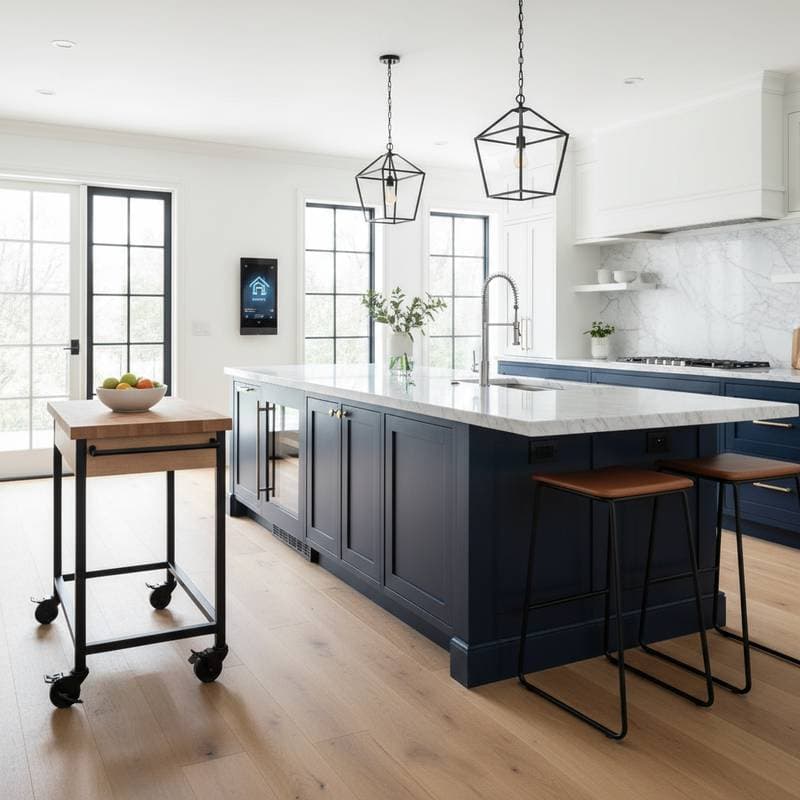
2025 Kitchen Island Costs: What You Will Actually Pay
A kitchen that lacks sufficient space or counter area often limits meal preparation and daily routines. Installing an island addresses these challenges by providing additional workspace, storage, and even seating. Costs vary widely, from inexpensive mobile carts starting at $300 to comprehensive custom setups exceeding $12,000 that incorporate advanced features such as integrated appliances.
This comprehensive guide examines realistic pricing based on current market trends. It outlines the primary expense categories, reveals factors that influence totals, and offers practical advice for decision-making. Whether you consider a do-it-yourself approach or professional services, these insights ensure informed choices aligned with your budget and spatial needs.
Key Components of Kitchen Island Expenses
The overall cost of a kitchen island derives from multiple elements, including materials, features, and installation. Budgeting effectively requires evaluating each part to allocate funds wisely. Below, each major category receives detailed attention, with price ranges reflecting 2025 estimates for average-sized islands measuring 4 to 6 feet in length.
Cabinetry and Structural Framework
The base structure, typically comprising cabinets or a sturdy frame, accounts for 25 to 40 percent of the total expense. Stock cabinets sourced from major retailers provide an economical choice, often ranging from $500 to $1,500 for basic assemblies in wood or laminate finishes. Semi-custom options, which allow minor adjustments in size and style, increase to $1,200 to $2,500.
For bespoke cabinetry tailored to your kitchen's dimensions and aesthetic, prices climb to $2,000 to $5,000 or more. Select durable hardwoods like maple or oak for longevity, or opt for engineered composites to balance cost and resilience. Consider the island's height—standard at 36 inches for counters or 42 inches for bar-style seating—to ensure ergonomic fit.
Countertop Selections and Their Impact
The countertop defines the island's visual appeal and practical utility, contributing 15 to 30 percent to costs. Affordable laminate surfaces, mimicking stone or wood grains, begin at $150 to $400 and resist stains effectively with proper sealing. Ceramic or porcelain tiles offer versatility in patterns, priced from $300 to $800, though grout maintenance proves essential.
Mid-tier selections like butcher block, crafted from sustainable woods such as acacia, range from $600 to $1,200 and invite food preparation directly on the surface. Premium materials dominate higher budgets: granite slabs cost $1,000 to $2,500, quartz composites $1,200 to $3,000, and marble $1,500 to $4,000, each requiring professional templating for precise cuts. Factor in edge treatments, such as beveled or bullnose profiles, which add $100 to $300.
Integrating Plumbing and Electrical Systems
Functional enhancements like sinks, dishwashers, or power outlets elevate convenience but introduce specialized costs, comprising 10 to 25 percent of the project. Basic plumbing for a sink, connecting to nearby lines within 10 feet, totals $500 to $1,500, including permits and materials like PEX piping. Longer runs or modifications to drain systems push expenses to $1,200 to $2,500.
Electrical additions, such as under-cabinet lighting or multiple receptacles, range from $300 to $1,000, depending on wiring complexity and GFCI requirements for safety. If incorporating a cooktop, gas line extensions add $400 to $800. Engage licensed contractors to comply with codes, such as NEC standards for outlets spaced no more than 48 inches apart, avoiding fines or rework.
Labor and Professional Installation Fees
Labor represents 20 to 40 percent of the budget, varying with project scope. Basic assembly of freestanding units costs $200 to $500, suitable for handy homeowners using tools like cordless drills and levels. However, full installations involving wall modifications or utility integrations demand skilled tradespeople, totaling $1,500 to $4,000.
Complex projects, such as reinforcing floor joists for load-bearing islands or aligning with existing cabinetry, may exceed $5,000 in labor alone. Obtain multiple quotes from certified installers, specifying timelines—typically 3 to 7 days—and warranties covering workmanship for at least one year. In urban areas, expect 10 to 20 percent premiums due to higher wage rates.
Unforeseen Expenses and Mitigation Strategies
Projects rarely proceed without minor hiccups, so allocate 10 to 15 percent of your budget as a buffer. Common surprises include discovering outdated wiring during electrical work, which necessitates panel upgrades costing $1,000 to $3,000. Similarly, rerouting HVAC ducts or subfloor reinforcements for stability can add $500 to $2,000.
Flooring disruptions, such as lifting tiles to access plumbing, require matching replacements at $200 to $600 per square yard. Ventilation needs for range hoods over cooktops involve ducting extensions priced at $300 to $1,000. Conduct a pre-installation inspection with a contractor to identify these risks early, using tools like stud finders or moisture meters for thorough assessment.
Strategic Planning for Optimal Results
Effective planning begins with precise measurements: sketch your kitchen layout, noting door swings and appliance placements to avoid obstructions. Maintain 42 to 48 inches of walkway clearance around the island for comfortable navigation, expanding to 60 inches in high-traffic homes. For overhangs accommodating bar stools, extend 12 to 15 inches beyond the base.
Simulate the design by marking outlines with masking tape, testing usability during mock meal prep. Align spending with your home's valuation—limit island costs to 10 to 15 percent of kitchen worth to preserve resale appeal. In compact kitchens under 100 square feet, consider slim profiles or wheeled alternatives that relocate easily, costing $300 to $1,000 while delivering flexibility.
Essential Advice from Industry Experts
Focus on utility first: integrate pull-out drawers for utensils or open shelving for cookbooks to streamline tasks. Select finishes that harmonize with cabinetry, using contrasting grains for visual interest without overwhelming the space. Integrate lighting strategically—position pendants 30 to 36 inches above the surface for task illumination, coordinating with structural elements like beams.
Seek professional input for load calculations, especially in older homes where floors may need bolstering. Prioritize low-maintenance surfaces: sealed quartz withstands spills better than unsealed wood. Ultimately, a well-designed island enhances daily life, increases property value by 5 to 10 percent, and creates a central hub for gatherings that endures for decades.