
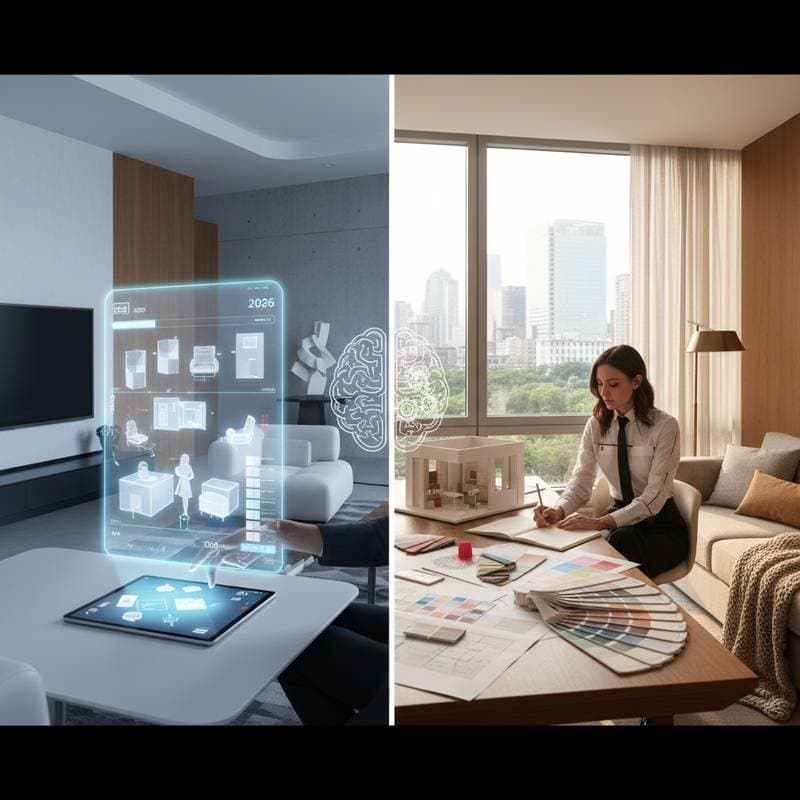
Comparing AI Design Tools and Professional Designers for Home Improvement
Both AI design tools and professional interior designers possess the potential to elevate living spaces, yet they operate through distinct methodologies. The key consideration involves aligning each option with specific objectives, financial constraints, and project timelines rather than declaring a universal superior choice.
Many homeowners confront the challenge of an uninspired room layout or color scheme. Digital AI platforms address this by producing design proposals, including room configurations, hue selections, and furnishing placements, often within moments. These solutions offer prompt outcomes with limited user input. However, the question persists: do such tools adequately substitute for the discerning perspective and experiential knowledge of a seasoned designer?
This analysis examines performance across essential criteria: expense, ease of use, innovative capacity, and comprehensive worth.
Advantages of AI Design Tools in Home Projects
AI platforms demonstrate particular prowess in rapidity and iterative testing. Users explore diverse aesthetics without initial material investments. For instance, to evaluate a kitchen in warm terracotta tones versus sleek minimalist whites, individuals upload images and adjust parameters to generate side-by-side renderings.
These applications further mitigate financial risks associated with errors. Digital simulations allow verification of element compatibility, such as confirming clearance for a large dining table prior to purchase. Advanced features in some tools perform precise measurements of areas and volumes, averting issues like ill-fitting cabinetry that necessitate returns or structural adjustments.
Accessibility represents another core benefit. No prior design education proves necessary, and platforms operate around the clock. For those balancing professional commitments and household responsibilities, this on-demand availability proves invaluable.
Nevertheless,outputs, while visually compelling, omit the nuanced judgment inherent to human insight. Professional designers maintain a decisive edge in this domain.
Superior Aspects of Professional Designers Over AI
Personalization stands as the paramount asset of a professional designer. These experts engage deeply with client lifestyles, identifying daily routines, pain points, and aspirational elements. They then craft environments that resonate on a personal level, fostering a sense of harmony and authenticity. AI may replicate stylistic trends, yet it struggles to capture subtle emotional layers that contribute to a space's welcoming character.
Professionals excel in procurement and project management as well. They possess in-depth knowledge of durable fabrics for family rooms, resilient flooring for entryways, and reputable artisans for custom installations. Established relationships with suppliers and tradespeople streamline processes, minimizing disruptions and unforeseen expenses.
Moreover, designers conceive homes as unified wholes. They ensure seamless transitions between areas, such as coordinating lighting schemes from hallways to adjacent bedrooms. In contrast, many AI tools emphasize isolated room treatments, potentially resulting in disjointed overall aesthetics.
Integrating AI and Professional Expertise for Optimal Home Design
Projects yielding the highest satisfaction frequently incorporate elements from both approaches. Begin with AI to develop preliminary sketches and mood boards, then engage a designer to enhance and implement these foundations.
This combined strategy conserves initial consultation costs while securing expert validation in critical phases. Designers value prepared clients who present tangible prototypes, as such materials facilitate efficient dialogue and adjustments.
Consider this structured process for integration:
- Ideation Phase: Leverage AI applications to brainstorm configurations, test color harmonies, and pinpoint stylistic preferences through virtual walkthroughs.
- Development Phase: Collaborate with a designer to assess structural viability, select sustainable materials, and integrate functional aspects like ergonomic workflows or energy-efficient fixtures.
- Implementation Phase: Delegate to the designer the orchestration of timelines, vendor coordination, and on-site supervision to realize the vision without compromise.
Such a method empowers users with creative autonomy alongside assured technical accuracy.
Practical Steps to Select and Apply Design Solutions
For minor updates, such as reconfiguring a home office or refreshing a guest bathroom, AI tools supply swift guidance and curb hasty decisions. They facilitate trials of desk placements, wall treatments, or accessory integrations, enabling informed choices that enhance usability.
Larger undertakings, including full renovations or additions, benefit most from professional involvement to guarantee regulatory adherence, such as zoning compliance or accessibility standards. This expertise safeguards investments, ensuring spaces remain appealing and operational for years.
Ultimately, synergy between AI innovation and designer proficiency unlocks unparalleled potential. AI fuels exploratory phases, while professionals refine and execute with precision. Homeowners emerge with environments that blend innovation, personalization, and durability.
Imagine settling into a thoughtfully curated den, where every detail supports relaxation and productivity. This outcome arises from deliberate selection and collaboration, transforming abstract ideas into tangible, enriching realities.