
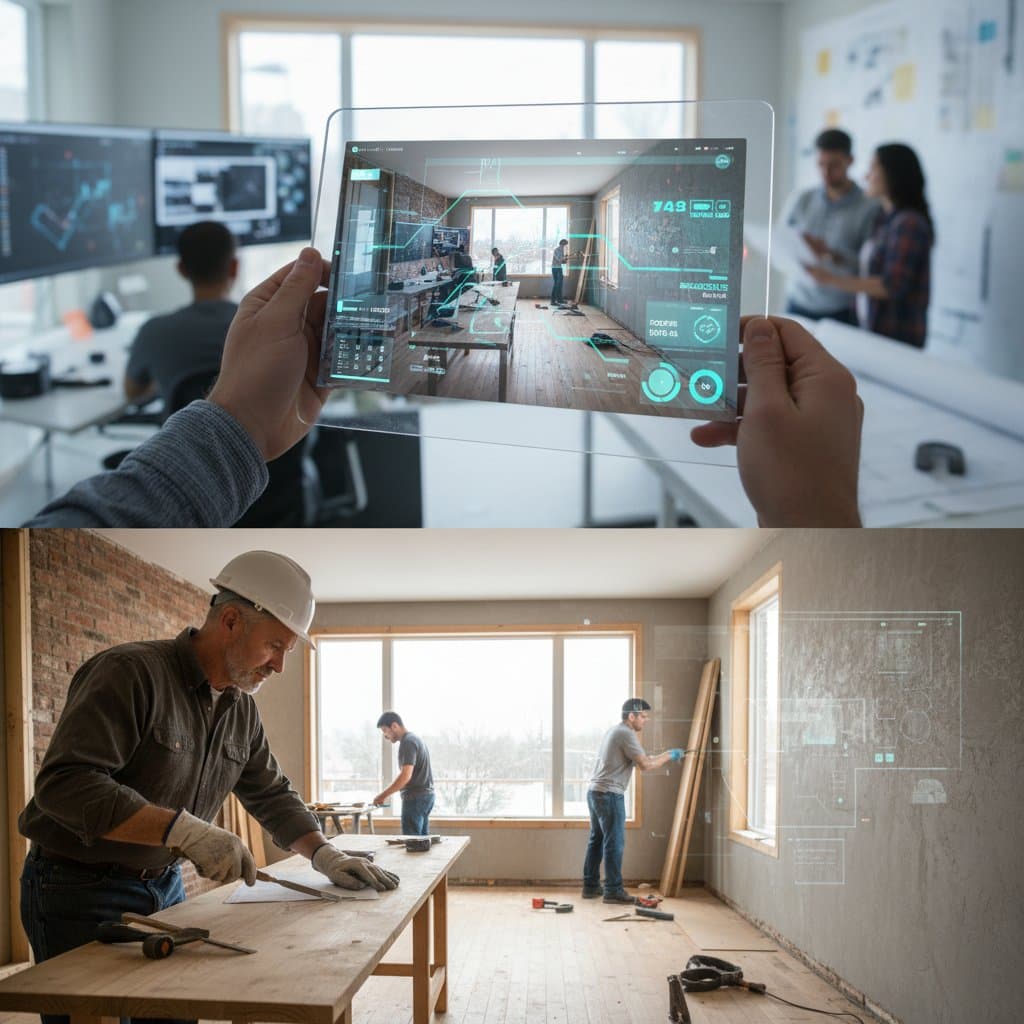
AI and Contractors: Shaping the Future of Home Remodeling
Homeowners increasingly turn to mobile apps for remodeling inspiration. These applications allow users to upload images of existing spaces, choose preferred styles, and generate detailed renderings in moments. The results often depict ideal lighting, harmonious finishes, and intuitive layouts. However, construction involves tangible challenges, such as persistent noise, pervasive odors, and schedules that extend beyond initial projections.
A central question arises: can artificial intelligence tools supplant the expertise, intuition, and skill of professional contractors? Advances in design, estimation, and planning technologies prompt homeowners to consider the balance between automated processes and human artistry.
Advances in AI-Driven Remodeling Planning
Design software has evolved from basic sketching tools to sophisticated systems. Current platforms analyze floor plans, assess material properties, and model lighting effects to forecast renovation outcomes prior to any physical work.
These tools assist homeowners by enabling them to:
- Develop concepts from photographs
- Project timelines and expenses
- Align selections with environmental criteria
- Produce 3D models for review
Such features alter project initiation. Individuals now experiment with virtual options, evaluate expenses immediately, and modify arrangements without soliciting bids.
Consider a scenario where a user submits an image of an aging bathroom and specifies a contemporary sustainable aesthetic. The tool promptly delivers a lifelike visualization incorporating eco-friendly surfaces, efficient appliances, and a cost projection. It also proposes budget-conscious substitutes that preserve visual coherence.
Enduring Strengths of Professional Contractors
Despite technological progress, these systems lack the perceptual acuity developed through extensive practical experience. Professionals discern subtle issues in aging structures, such as concealed water intrusion, unstable underlayment, or designs incompatible with regional regulations.
Software computes dimensions precisely, yet it cannot sense the tension in a deformed support or identify humidity fluctuations indicating airflow deficiencies. Experts provide an intuitive grasp that algorithms fail to duplicate.
Furthermore, digital suggestions may overlook practical limitations. A rendering might feature an elegant suspended fixture, disregarding underlying pipe arrangements. Professionals serve as the essential intermediary, converting ideal visions into feasible executions.
Comparing Costs: Automated Projections Versus Expert Assessments
AI platforms attract users with promises of economical planning. Their forecasts frequently undercut conventional bids by omitting variables like workforce variables and unexpected modifications.
Typical AI outputs include:
- Material pricing forecasts: Accurate to within 10 to 15 percent of market values
- Duration estimates: Derived from standard labor metrics and scope
- Environmental ratings: Drawn from supplier information and efficiency records
Professionals, however, incorporate historical knowledge and buffers for variability. They account for structural uncertainties, permitting timelines, and the nuances of quality execution.
An AI might project a bathroom renovation at $12,000, whereas an expert could range from $15,000 to $18,000, including allowances for pipe discrepancies, waste removal, and concealed issues within finishes.
Homeowners benefit from an integrated method. Employ AI to define initial financial parameters, then engage a professional for adjustments based on site-specific insights. This synergy fosters clarity and averts monetary surprises during implementation.
Infusing Design with Personal Resonance
Effective design evokes feelings and narratives. It embodies individual traits, recollections, and ambitions. Automated systems excel at mirroring prevailing styles but falter in capturing subjective essence. Interpreting a request like "evoke the ambiance of a cherished family veranda" challenges AI, which processes palettes, textures, and illumination data without grasping evocative sentiment.
Experts convert such intangibles into tangible elements. They observe spatial navigation, preferred viewpoints, and placements of meaningful items. These insights yield environments that resonate deeply, surpassing mere optimization.
AI enhances this process by evaluating numerous configurations rapidly, assessing daylight distribution, and gauging sound dynamics. The alliance of intuitive design and computational accuracy yields spaces that excel in form and utility.
Navigating Safety, Regulations, and Standards
Remodeling extends beyond aesthetics to encompass protective measures, approvals, and evaluations. AI increasingly embeds jurisdictional guidelines into simulations, though limitations persist.
Licensed professionals hold qualifications ensuring responsibility. They adhere to norms for frameworks, wiring, and conduits, guaranteeing that attractive updates comply with protective protocols.
Software could propose eliminating a support wall for fluid interiors, overlooking engineering demands. An qualified specialist identifies hazards and recommends reinforced alternatives. Human judgment proves vital here.
Users should view AI outputs as preliminary ideas. For significant alterations to frameworks or systems, professional consultation remains crucial. Authorities typically mandate certified plans or expert endorsements for validation.
Promoting Sustainability and Enduring Benefits
AI excels in environmental analysis within remodeling. Platforms swiftly compute material emissions, forecast utility reductions, and propose enhancements for certification alignment.
Through such tools, users discover that opting for reclaimed aggregates minimizes refuse or that enhanced glazing might cut energy use by 20 percent. Rapid assessments encourage informed, planet-friendly decisions.
Experts confirm suitability for regional conditions. A recommendation for fibrous wood surfaces might suit ideals, but in moist areas, professionals emphasize sealing to prevent distortion. Combined input yields strategies that balance innovation with reliability.
Evolving the Renovation Experience
Renovation now blends digital previews with interpersonal dialogue. Virtual trials build user assurance, allowing safe exploration of concepts prior to investment.
This accessibility proves beneficial, yet it risks inflated anticipations. Actual hues may vary from simulations, or illumination could alter atmospheres, leading to dissatisfaction.
Professionals adapt by addressing both logistical and virtual facets. Many integrate modeling into offerings, scrutinizing ideas for practicality and realizing outcomes that merge fantasy with precision.
Selecting AI Tools Strategically
AI suits:
- Initial ideation: Surveying options and financial benchmarks
- Financial outlining: Defining viable scopes pre-consultation
- Simple undertakings: Surface-level changes like coatings, fixtures, or furnishings
- Previews: Experimenting with configurations or selections pre-acquisition
Complex endeavors with conduits, circuits, or frameworks demand specialists. These involve protective and normative considerations beyond digital scope.
Discerning users position AI as a preparatory aid, not a substitute. Optimal projects initiate digitally, advance via expert review, and conclude with masterful implementation.
Fostering Integrated Professional Workflows
Emerging partnerships unite specialists, creators, and technologies. Professionals leverage AI to:
- Accelerate bids from submitted diagrams
- Streamline procurement to curb excess
- Present varied visuals to stakeholders
- Model utility outcomes for ecological improvements
Such fusion enhances delivery. Stakeholders access accurate previews, while experts reduce routine burdens. The outcome streamlines progression, harmonizing invention and productivity.
Essential Strategies for Effective Remodeling
To integrate AI and expertise successfully:
- Define objectives precisely. Specify desired utility and atmosphere before engaging software.
- Limit AI to ideation. Regard visuals as motivational, not conclusive.
- Confirm all framework modifications. Seek certified input for supports, circuits, or conduits.
- Incorporate adaptability in finances. Augment AI baselines by 10 to 20 percent for variables.
- Emphasize ecological viability. Request durable green selections from both sources.
- Maintain realistic perspectives. Simulations omit the organic qualities of lived spaces.
This blended approach delivers updates that integrate modernity with skilled execution.
Realizing Balanced Renovation Outcomes
As construction concludes and spaces emerge, the interplay of innovation and tradition becomes evident. Digital guidance shapes concepts, while expert execution imparts authenticity. Precise alignments, seamless integrations, and nuanced illuminations reflect irreplaceable human touch.
In advancing home enhancement, achievement stems from synergy, not opposition. AI streamlines foresight and reduces ambiguity, as professionals secure elegance, security, and durability. Future residences will blend computational foresight with artisanal realization.