
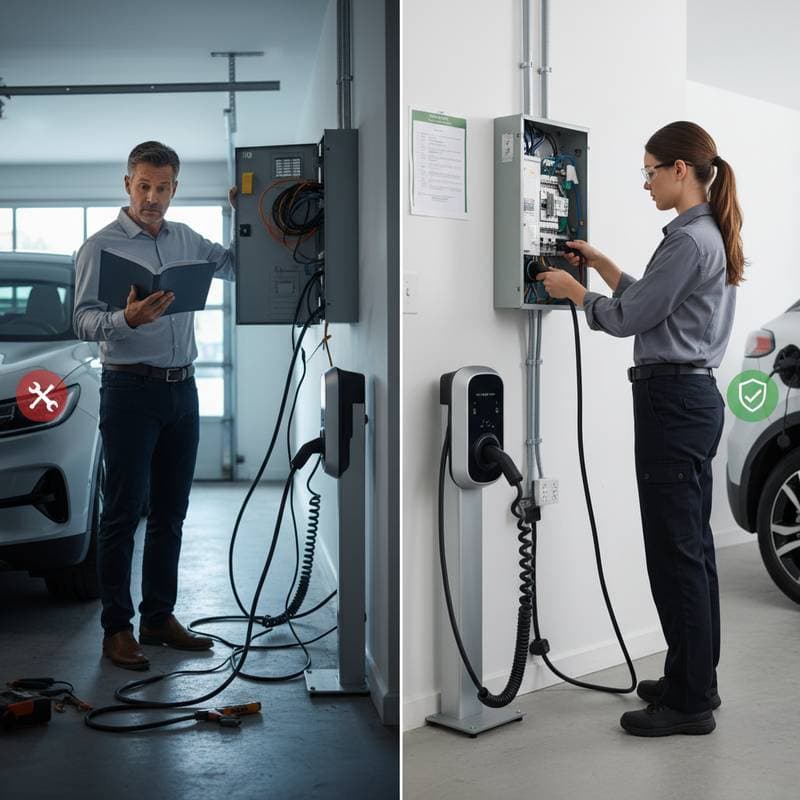
EV Charger DIY Risks: When Professional Installation Is Essential
Installing an EV charger involves more than basic tools and instructions. This project connects directly to your home electrical system and carries implications for safety, code compliance, and insurance coverage. Homeowners who attempt full installation without proper qualifications often encounter hidden complications that lead to equipment damage or denied claims.
The following sections clarify the differences between charger types and outline the precise conditions under which professional help becomes necessary.
EV Charger Levels and Installation Requirements
Level 1 chargers connect to a standard 120-volt household outlet and add roughly four to five miles of range each hour. These units need only a dedicated circuit and an undamaged receptacle, making them suitable for limited homeowner inspection when no wiring changes are required.
Level 2 chargers operate on 240 volts and deliver twenty to thirty miles of range per hour. They require new wiring runs, a dedicated breaker, and often a panel upgrade. Local codes typically mandate that licensed electricians perform all work beyond simple plug-in models because improper connections create overheating and fire hazards.
Cost Comparison of Installation Approaches
Homeowners sometimes expect savings from a do-it-yourself approach, yet material expenses plus inspection failures frequently erase those gains.
- DIY Level 1 plug-in units cost between zero and two hundred dollars and take one to two hours with no permit needed.
- Professional Level 2 installation ranges from six hundred to two thousand dollars, requires half a day, and includes required permits.
- Attempted DIY Level 2 work costs three hundred to seven hundred dollars in materials alone, demands a weekend, and frequently results in permit denial without a licensed signature.
Professional work also supplies documentation that supports future home sales and warranty claims.
Tasks Homeowners Can Handle Safely
Certain preparation steps remain within homeowner capability when no live connections are involved.
- Mount the charger bracket and clear the installation area.
- Install conduit runs for cable protection before any wiring occurs.
- Verify outlet voltage with a multimeter to confirm adequate supply.
A licensed electrician should still inspect the completed assembly and perform final terminations to maintain compliance.
Indicators That Require Immediate Professional Attention
Certain conditions signal elevated risk and demand expert intervention before any work begins.
- Visible sparks, flickering lights, or frequent breaker trips during appliance use.
- An older or fully loaded electrical panel that lacks spare breaker positions.
- Any requirement for 240-volt circuits or dedicated wiring.
- Presence of aluminum wiring that needs specialized connectors.
- Uncertainty about grounding methods or conduit specifications.
These factors increase the likelihood of equipment failure or personal injury when left unaddressed.
Advantages of Licensed Installation Over Time
A code-compliant installation protects both the vehicle charging system and household wiring from excessive wear. Consistent power delivery reduces stress on onboard vehicle components and prevents intermittent faults.
Electricians supply the inspection records needed for insurance files and future property transfers. Annual connection checks further maintain performance as temperature changes affect terminals.
Steps That Support Long-Term Reliability
- Select a charger location that allows the cable to reach the vehicle without tension.
- Confirm strong Wi-Fi coverage for smart features such as scheduling.
- Mark every new breaker clearly for future service needs.
- Retain all permits, inspection certificates, and manuals in a single file.
- Arrange periodic safety inspections to catch loosening connections early.
These measures preserve equipment life and support insurance requirements.
Protecting Your Home Electrical Investment
Proper planning and professional oversight convert an EV charger project into a durable home improvement. Documentation from licensed work provides lasting proof of compliance that benefits both daily use and future ownership transitions.