
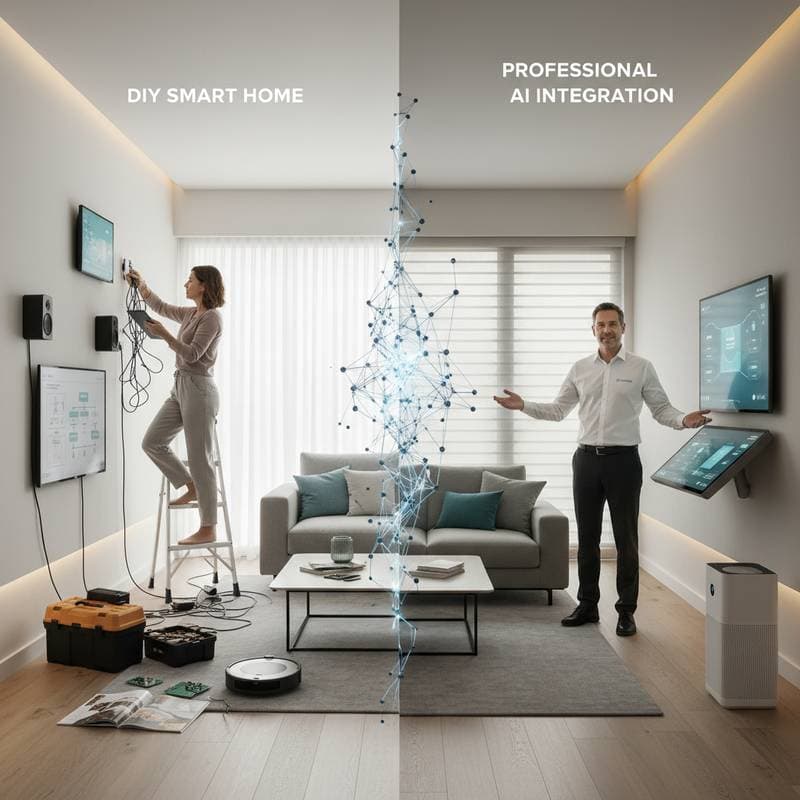
Should You Attempt DIY AI Remodeling or Hire an Expert?
Homeowners often envision effortless control over lighting, climate, and security through voice commands after viewing demonstration videos. Advances in smart technology make such integrations more approachable, yet the decision to pursue DIY AI remodeling or engage professionals hinges on individual objectives, technical proficiency, and expectations for ongoing support. This examination outlines both approaches to facilitate a choice that optimizes expenses, technical demands, and enduring performance.
The Core Decision Framework
Evaluate these essential factors prior to selecting a path:
-
Project Complexity
Basic installations of isolated smart devices suit DIY methods, whereas comprehensive AI systems that learn user patterns demand expert programming and hardware synchronization. -
Technical Proficiency
Proficiency in network management, electrical wiring, and application settings proves vital. AI platforms depend on robust Wi-Fi, interoperable standards, and accurate device linkages; persistent issues with basic connectivity signal the value of professional intervention. -
Ongoing Upkeep Requirements
Systems require regular software updates, sensor adjustments, and compatibility checks. Professionals frequently include maintenance agreements with remote monitoring, whereas DIY users assume full accountability for resolutions.
What DIY AI Remodeling Involves
Individuals who relish technical projects and possess solid technology knowledge find DIY AI remodeling fulfilling in terms of savings and innovation. This method imposes defined limits, however, particularly for expansive implementations.
Key Steps in a DIY Approach
-
System Planning
Outline the functions for AI oversight, commencing with essentials like illumination, temperature regulation, and surveillance. Select a versatile central controller compatible with diverse manufacturers to maintain adaptability. -
Device Selection for Compatibility
Prioritize seamless interoperability. Conflicts arise when products from varied brands resist integration; opt for items aligned with standards such as Matter, Zigbee, or unified Wi-Fi networks. -
Device Installation and Setup
Follow application-guided procedures for most units. Complications emerge in orchestrating multi-condition automations, for instance, activating lights upon motion detection solely within designated hours. -
Testing and Issue Resolution
Conduct repeated simulations of automation sequences. Position sensors optimally and confirm network stability; maintain detailed records of configurations for subsequent adjustments.
Cost and Time Estimates
DIY AI remodeling generally spans $800 to $3,000, scaled by the extent of integrated components. Allocate 20 to 40 hours for investigation, acquisition, deployment, and refinement. Labor avoidance yields primary economies, though expenses may escalate from discarding mismatched equipment.
Common DIY Challenges
- Network overloads causing erratic device interactions
- Struggles to link legacy appliances with modern AI
- Gaps in configuring data safeguards and encryption
- Disruptions from vendor software revisions invalidating setups
Such hurdles enhance enjoyment for those who thrive on iterative problem-solving, yet they overwhelm others swiftly.
What Professional Installation Offers
Engaging specialists converts AI remodeling into a collaborative endeavor focused on peak performance. Installers transcend mere connections to engineer solutions emphasizing security, efficiency, and intuitive operation.
Key Advantages
-
Thorough System Design
Assessors review electrical infrastructure, wireless coverage, and power distribution to propose suitable hardware. Designs accommodate future expansions without extensive overhauls. -
Regulatory Adherence and Risk Mitigation
Integrations involving power sources, such as intelligent circuit panels or climate controllers, necessitate compliance with building codes. Qualified technicians identify and avert hazards overlooked by novices. -
Advanced Integration Capabilities
Specialists unify disparate brands via proprietary platforms, enabling nuanced tailoring unavailable in standard applications. -
Sustained Assistance and Monitoring
Providers extend remote troubleshooting and contractual upkeep, resolving malfunctions without homeowner intervention or extended research.
Cost and Time Estimates
Professional services range from $4,000 to $15,000, influenced by property dimensions and integration scope. Timelines extend from days to weeks, incorporating any necessary infrastructure modifications. Premium pricing encompasses workmanship, assurances, and specialized tools.
When Professional Help Becomes Essential
- Plans incorporate AI with heating, ventilation, electrical panels, or renewable energy
- Inadequate wireless signals necessitate advanced mesh deployments
- Security features demand robust encryption and footage oversight
- Desire for a consolidated dashboard managing media, illumination, and environmental controls
These scenarios entail intricate hardware tuning and algorithmic refinements beyond entry-level tools.
Safety and Privacy Considerations
AI platforms gather extensive behavioral data, underscoring the need for stringent protections regardless of installation method. Favor devices supporting on-site data retention over cloud-dependent alternatives. Implement unique credentials and multifactor verification across management interfaces.
Electrical precautions remain paramount. Intelligent relays and controllers often require dedicated wiring or precise amperage. Deactivate breakers prior to modifications and employ multimeters for validation; consult certified electricians for any ambiguity to eliminate hazards.
Comparing DIY vs. Professional AI Remodeling
| Factor | DIY Approach | Professional Installation |
|---|---|---|
| Cost Range | $800 - $3,000 | $4,000 - $15,000 |
| Time Commitment | 20 - 40 hours | Few days to several weeks |
| Skill Level Required | Intermediate to advanced tech knowledge | Minimal for homeowner |
| Warranty and Support | Limited to manufacturer policies | Often includes service plans |
| Customization Depth | Limited by app capabilities | Deep system integration possible |
| Risk Level | Higher chance of misconfiguration | Lower, handled by certified installers |
This overview underscores DIY viability for modest, skill-intensive endeavors and professional merits for ambitious, dependable deployments.
Making the Right Choice for Your Home
Identify core priorities to guide the selection. Modest explorations into voice-activated lighting or basic controls align with DIY affordability and skill-building. Aspirations for holistic AI orchestration with predictive adaptations favor expert involvement for robustness and compliance.
Hybrid models prove effective: Initiate with self-managed components, then enlist professionals for cohesive unification. This phased tactic distributes expenditures and builds foundational knowledge ahead of broader commitments.
Strategies for Long-Term System Upkeep
Preserve functionality through routine assessments. Schedule quarterly checks for software patches and hardware integrity to preempt failures. Monitor energy consumption patterns via built-in analytics to refine automations and curb inefficiencies.
Establish backup protocols, including offline modes for critical functions like security. Engage community forums or manufacturer resources for emerging best practices, ensuring the system evolves alongside technological progress.
Pro Tips for Success
- Initiate Modestly. Target a single domain, such as surveillance or illumination, to build momentum before broader applications.
- Record Configurations. Compile digital logs of setups, access codes, and connectivity details for efficient retrieval.
- Emphasize Safeguards. Deploy robust encryption and isolated networks to shield against intrusions.
- Plan for Expansion. Invest in modular architectures that accommodate future innovations without disruption.
- Consult Early. Obtain preliminary professional input, even for DIY plans, to sidestep expensive errors.
Adapting Your Home to Intelligent Living
A well-executed AI integration elevates daily routines, fostering efficiency and personalization. Whether through personal ingenuity or expert collaboration, the result yields a responsive environment attuned to your preferences. Commit to informed choices and diligent care to maximize these benefits over time.