
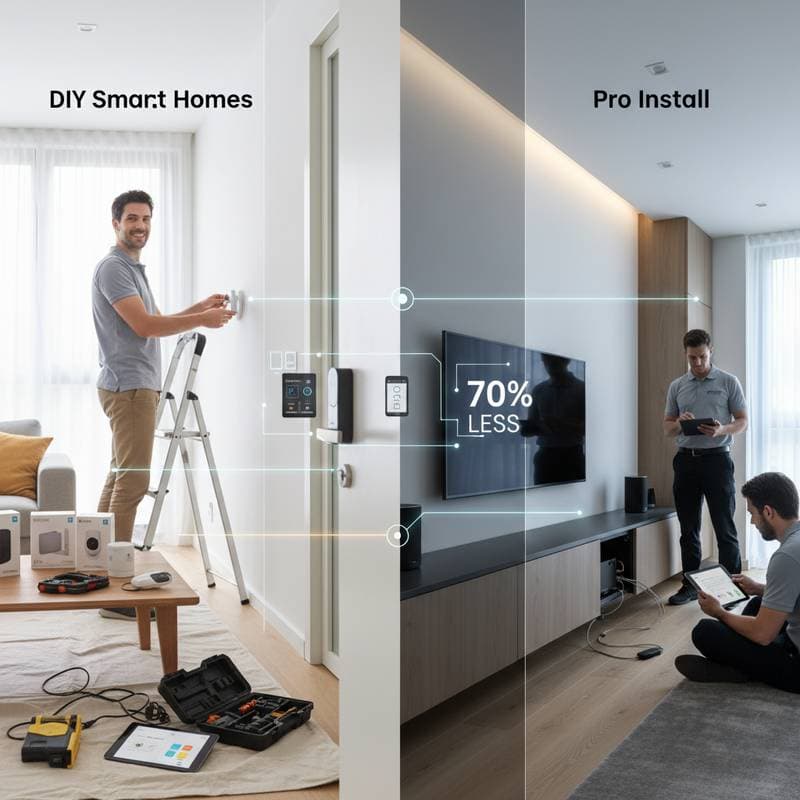
Discover Savings: DIY Smart Home Installation Compared to Professional Services
Imagine entering your home after a demanding day. Lights activate softly, your preferred music plays, the temperature shifts to your ideal level, and the security system secures the entrance. This seamless experience defines a smart home. Yet, achieving it involves choosing between self-installation or expert assistance.
The choice hinges on budget, technical ability, and desired oversight. Self-installation emphasizes cost efficiency and personalization. Expert services prioritize dependability and accuracy. Grasping the differences enables selection of an approach aligned with personal needs and financial constraints.
Advantages of Self-Installing Smart Home Devices
Self-installation resembles assembling a custom system tailored to your space. Homeowners gain insight into their infrastructure and the ability to grow the setup gradually.
Primary Benefits
-
Reduced Initial Expenses: Eliminating labor fees allows allocation of funds toward premium equipment. For instance, a basic setup with lights, plugs, and a thermostat might cost $1,500 through self-installation, versus $5,000 with professional involvement.
-
Adaptability and Growth Potential: Begin with essential items like smart bulbs or outlets, then incorporate advanced features such as automated shades or door locks over time. This phased approach prevents overwhelming expenditures.
-
Skill Development Through Practice: Handling installations builds knowledge in areas like electrical basics, wireless networking, and device synchronization. Resources such as manufacturer guides and online tutorials support this process.
Important Factors to Consider
Self-installation demands time and determination. Devices from different manufacturers may face integration challenges without a unifying platform. Signal strength issues can affect operations in expansive properties or structures with dense materials.
Homeowners assume duties for ongoing care. This includes applying software updates, resolving network interruptions, and adjusting routines following system modifications. Initial setup might require several hours per device, plus periodic checks to maintain efficiency.
To illustrate, integrating a smart lock with an existing doorbell camera could involve configuring APIs or selecting compatible brands like those supporting Zigbee or Z-Wave protocols. Testing in varied conditions ensures consistent performance.
Integrating Self-Installation with Expert Services
A balanced strategy often yields the most effective outcomes. Engage professionals for complex elements like structural wiring or central controllers, while managing simpler additions independently. This method secures professional quality in critical areas and retains personal involvement elsewhere.
Consider outsourcing the installation of a whole-home hub, embedded lighting controls, and surveillance wiring. Subsequently, incorporate wireless elements such as motion sensors, voice-activated speakers, and appliance modules. Costs for this hybrid could total $3,000, achieving 40-50% savings over full professional service.
This setup facilitates smoother expansions. A solid base simplifies adding components like environmental monitors or entertainment integrations. Professionals can also advise on scalable architectures during initial consultations, ensuring future-proofing.
For larger homes, experts might recommend mesh networks to extend coverage, which homeowners can then maintain. Documenting configurations during professional phases aids independent troubleshooting later.
Essential Strategies for Effective Implementation
-
Design a Cohesive System from the Start: Research interoperability standards before purchasing. Opt for ecosystems like those from major platforms that support multiple protocols to minimize conflicts.
-
Experiment in Limited Areas First: Implement a single zone, such as the kitchen, to evaluate usability. Observe how automations influence routines, like linking lights to motion detection for energy conservation.
-
Select Durable and Versatile Products: Focus on items with strong user reviews and multi-platform compatibility. Examples include thermostats that integrate with both voice assistants and mobile apps.
-
Establish Routine Checks: Conduct evaluations every three months. Verify connections, update firmware, and recalibrate sensors to prevent lapses in functionality.
-
Allocate Funds for Future Enhancements: Smart systems develop with user needs. Reserve 20% of the initial budget annually for new features, such as AI-driven security analytics.
-
Secure Your Network: Use strong passwords and separate guest networks for devices. This protects against vulnerabilities, especially with internet-connected components.
-
Track Energy and Cost Impacts: Monitor usage through app dashboards to quantify savings, like reduced utility bills from automated heating adjustments.
Enhancing Daily Life Through Smart Automation
A smart home transcends mere convenience; it reshapes interactions with living spaces. Automated lighting reduces energy consumption by 20-30%, while responsive security enhances peace of mind. These elements foster an environment that anticipates needs.
The approach chosen—whether fully self-directed, expert-led, or combined—shapes the outcome. Prioritizing planning and maintenance ensures sustained benefits. Ultimately, this investment cultivates a residence that aligns with lifestyle priorities, delivering efficiency and tranquility.