
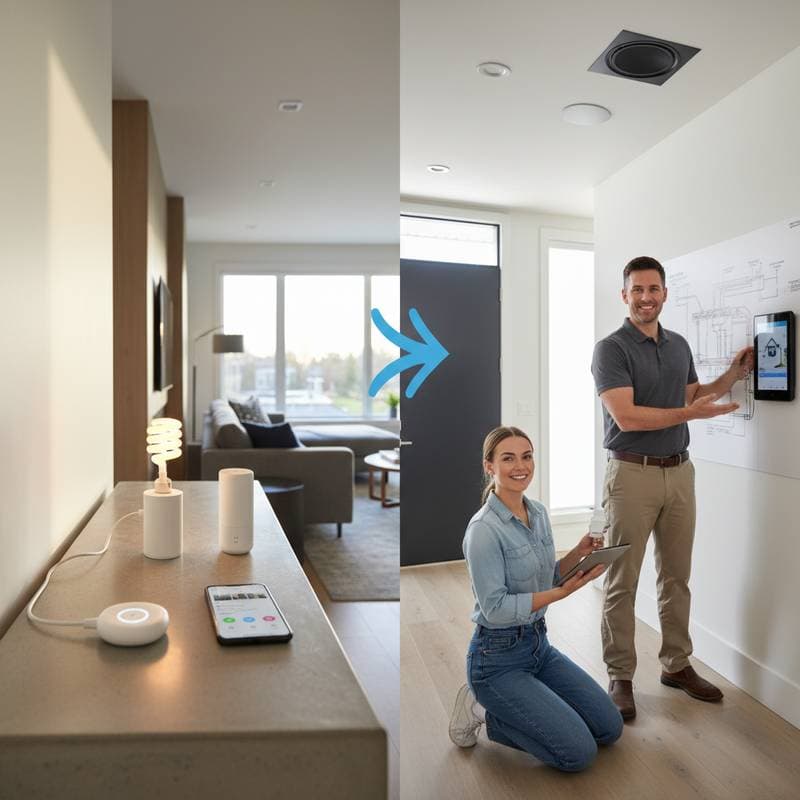
DIY Smart Home: Accessible Upgrades or Professional Essentials?
Many homeowners encounter hesitation when facing unopened packages of smart devices, such as bulbs or doorbells. The promise of a connected home excites, yet the array of applications, wiring, and compatibility concerns often overwhelms. This guide clarifies which projects suit independent installation and which demand professional expertise to ensure reliability from the outset. Numerous smart enhancements prove straightforward, while select others require specialized skills for optimal performance.
The following sections delineate projects feasible over a weekend versus those that justify professional involvement.
Straightforward DIY Projects for Immediate Results
Certain smart devices prioritize user-friendly design, allowing homeowners to achieve automation without extensive effort. These installations typically require less than one hour, involve minimal expense, and provide swift technological improvements to daily routines.
1. Smart Plugs and Outlets
Smart plugs serve as an ideal introduction to home automation. Insert the plug into a standard outlet, establish a Wi-Fi connection, and integrate it with a voice assistant through the companion application. Prices range from $10 to $30 per unit, with setup completing in under ten minutes. Apply them to control lamps, fans, or appliances like coffee makers, enabling remote operation and automated schedules for enhanced convenience.
2. Smart Bulbs
Installing a smart bulb mirrors the simplicity of replacing a traditional one. These bulbs link via Bluetooth or Wi-Fi, supporting features such as dimming, color adjustment, and voice activation. Costs vary from $15 to $50 per bulb, influenced by lumen output and color capabilities. Benefits include customizable ambiance for evenings and programmed schedules that promote energy conservation.
3. Smart Speakers and Displays
A smart speaker establishes the core for broader automation ecosystems. Voice directives manage lighting, audio playback, temperature settings, and door access as the system grows. Units price between $40 and $200, with configuration guided by an intuitive application process. This addition facilitates gradual expansion into sophisticated smart functionalities.
DIY Projects Requiring Moderate Effort
Additional upgrades remain within reach for determined individuals, though they necessitate greater preparation and technical familiarity. These tasks may include basic wiring, mounting hardware, or detailed application settings, which could challenge beginners.
1. Smart Thermostats
Smart thermostats reduce energy costs for heating and cooling by 10 to 15 percent through intelligent adjustments. Installation spans approximately one hour for systems with existing compatible wiring. Models range from $120 to $300 in price. Before proceeding, disconnect power to the HVAC unit and photograph current wire connections to facilitate accurate reassembly.
2. Smart Doorbells and Cameras
These additions enhance security through real-time monitoring and notifications. Setup might require drilling for mounting or linking to a doorbell transformer. Devices cost $100 to $250 each. Opt for battery-powered models to simplify the process; wired variants demand electrical proficiency. Professional assistance, priced at $100 to $150, proves valuable if electrical work feels daunting.
3. Smart Locks
Upgrading a deadbolt to a smart lock involves roughly 30 minutes and tools limited to a screwdriver. Prices fall between $120 and $250. Alignment demands precision during installation. Post-setup, remote locking, digital key sharing, and activity tracking become available, delivering substantial gains in accessibility and protection.
Projects Best Handled by Professionals
Certain initiatives appear uncomplicated initially but evolve into intricate challenges involving networks or electrical systems. Expert intervention guarantees safe, secure, and effective outcomes.
1. Whole-Home Automation Systems
Seamless coordination of lighting, climate control, security, and media requires professional orchestration to avoid integration pitfalls. Installation fees span $1,000 to $3,000, scaled to the system's scope. Technicians also configure for compatibility with emerging technologies and updates, safeguarding long-term viability.
2. Smart Lighting Panels and Switches
Converting standard switches to smart panels entails high-voltage electrical modifications. Errors risk system damage or warranty invalidation. Engage a licensed electrician for $150 to $250 per switch to uphold safety standards and regulatory adherence.
3. Comprehensive Security Systems and Network Enhancements
Deploying advanced security or mesh Wi-Fi involves wall penetrations, cable routing, and router optimization. Specialists assess home layouts for signal strength, position cameras effectively, and implement encrypted storage solutions. Although DIY options exist, professional tuning maximizes performance and safeguards data integrity.
Essential Strategies for Effective Implementation
- Begin modestly with items like plugs or bulbs to build familiarity before pursuing extensive automation.
- Verify ecosystem alignment, ensuring devices support platforms such as Alexa, Google Assistant, or Apple HomeKit.
- Document all connections with labels during wiring tasks to prevent future disassembly issues.
- Strengthen network security by refreshing router credentials and activating two-factor authentication for device access.
- Select equipment with outage resilience, including battery backups or manual overrides, to maintain functionality during disruptions.
Advancing Your Smart Home Integration
With these insights, homeowners gain confidence to select and execute upgrades that align with skill levels and objectives. Incremental additions foster a cohesive environment that enhances efficiency and comfort. Regular maintenance, such as firmware updates and compatibility checks, sustains the system's performance over time. Ultimately, a well-planned smart home delivers enduring value through tailored automation that adapts to evolving needs.