
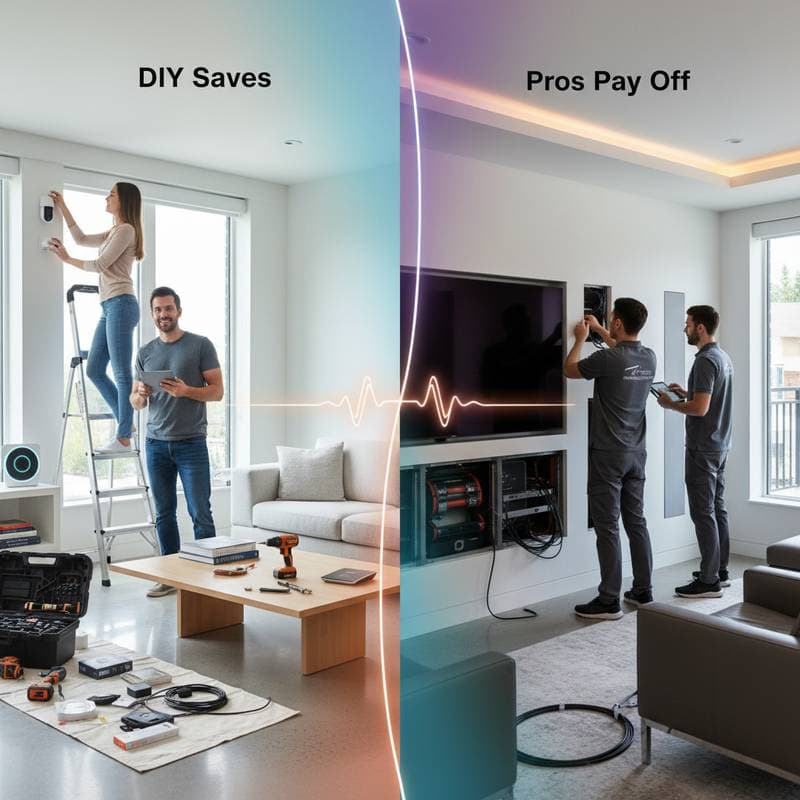
DIY Versus Professional: Essential Smart Home Cost Insights
The decision to install smart home devices yourself or hire professionals hinges on your financial resources, technical abilities, and the intricacy of the intended system. Smart home technology delivers enhanced convenience and operational efficiency, yet unforeseen expenses frequently arise from setup errors or integration challenges. Grasping the complete cost landscape enables you to determine if a self-directed project aligns with your objectives or if professional assistance offers greater value.
Primary Factors Influencing Expenses
Smart home initiatives exist on a continuum of complexity. At the basic level, you might add smart bulbs and a Wi-Fi-enabled thermostat. At the advanced end, the project could encompass wiring for security cameras, motorized window treatments, and interconnected lighting controls. These variations directly impact expenses, required time, and potential technical difficulties.
- Self-installation costs: Generally range from $200 to $1,000 for initial setups including lights, temperature controls, and power outlets.
- Expert installation costs: Often fall between $1,500 and $6,000 for cohesive systems featuring central hubs, motion detectors, and comprehensive automation.
- Combined strategy costs: Typically $800 to $2,500, allowing you to manage straightforward components while engaging specialists for cabling, network configuration, or surveillance elements.
These figures vary according to your residence's design, device interoperability, and the necessity for electrical or network infrastructure. Allocate additional budget for unforeseen items such as adapters, mounting hardware, and signal boosters.
Scenarios Where Self-Installation Excels
Self-directed smart home endeavors suit renters, apartment dwellers, or individuals experimenting with automation prior to broader commitments. Devices that operate on batteries or plug directly into outlets simplify the process. Many brands provide intuitive mobile applications, enabling completion within a few hours.
Projects well-suited for self-installation encompass:
- Wi-Fi-connected smart bulbs and light switches
- Voice-activated assistants and audio devices
- Battery-operated surveillance cameras
- Intelligent power outlets for household appliances
- Simple thermostats without extensive rewiring
If you possess patience, follow detailed guides meticulously, and handle network troubleshooting, you avoid substantial labor fees. Maintain records of your configurations to facilitate future enhancements or property sales. Prospective buyers value transparency regarding installed features and their operations.
Circumstances Requiring Expert Intervention
Certain smart setups demand more than basic app pairings. Projects involving permanent electrical modifications, surveillance oversight, or climate control linkages necessitate professional involvement for safety and reliability. Certified experts verify adherence to building regulations and preserve device guarantees.
Consider hiring professionals in these situations:
- When integrating devices from diverse brands through a unified controller
- For bespoke scripting of automated routines or environmental scenes
- If your wireless network exhibits weak signals requiring mesh extensions
- When linking access controls or automated entryways to current security frameworks
Specialists frequently offer detailed system diagrams, optimized connectivity, and ongoing assistance. Such support minimizes operational issues and safeguards your expenditure, particularly in expansive residences or divided areas.
Overlooked Expenses in Smart Home Budgeting
Planning for smart home additions extends past initial purchases and installation fees. Recurring charges and scalability needs contribute to the lifetime investment.
Frequently underestimated elements include:
- Monthly subscriptions for remote access or premium functionalities
- Enhancements to your internet infrastructure to support additional connected items
- Periodic replacements for power sources in cordless detectors and remotes
- Software revisions that may demand expert aid or full system reboots
Neglecting these aspects can transform an economical self-setup into a persistent burden. Review product agreements thoroughly and forecast maintenance outlays prior to system growth.
Prioritizing Safety and Regulatory Adherence
Although smart gadgets appear benign, faulty electrical connections risk circuit failures, information breaches, or ignition dangers. Components interfacing with your main power distribution or heating systems require specialist evaluation. Verify that any hired personnel possess valid certifications and coverage, and obtain written confirmation of completed tasks. This documentation supports insurance processes or property transfer requirements.
Maximizing Long-Term Benefits and Adaptability
An effectively implemented smart home enhances real estate appeal and draws technologically inclined purchasers. Expert orchestration promotes energy conservation, lowering monthly bills and advancing eco-friendly practices. While self-managed systems conserve upfront costs, they might necessitate repeated overhauls as protocols evolve.
Practical Strategies for Optimal Results
Commence with a unified ecosystem boasting robust software and defined expansion options. Organize all purchase records, device identifiers, and setup details in a centralized repository. Seek professional counsel for any electrical or significant connectivity tasks.
After activation, perform routine evaluations. Refresh software versions, monitor power levels, and evaluate network efficiency to ensure sustained performance.