
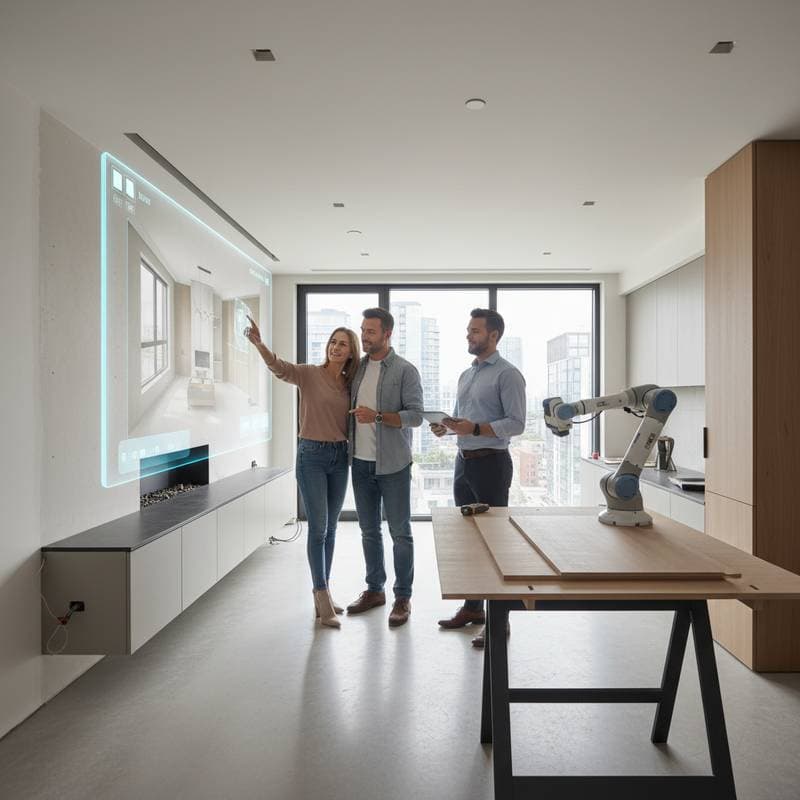
The Rise of AI in Home Improvement: Implications for Your Remodel
If you have ever waited two weeks for a contractor to return a call or observed a renovation budget double during the project, you likely have envisioned a smoother process for home improvement. That vision arrives now through AI-driven tools that reshape home design, remodeling, and maintenance. Homeowners can plan a kitchen renovation, create a materials list, and obtain a cost estimate within minutes, all without placing a telephone call.
This evolution prompts a key question: when intelligent software designs, measures, and manages projects with exceptional precision, what role remains for human contractors? The outcome proves more collaborative than anticipated. AI in home improvement empowers homeowners with enhanced control, clarity, and confidence throughout each endeavor.
The following sections examine this emerging landscape, its influence on costs and timelines, and strategies to maximize its benefits.
AI Integration from Design to Construction
After completing the design phase, AI extends its utility to the construction site in innovative manners. Intelligent project management platforms monitor timelines, deliveries, and workforce schedules. Image recognition technologies assess progress and detect issues before they escalate into expensive problems. Certain systems employ predictive analytics to foresee supply disruptions or weather interruptions.
Contractors utilizing these AI solutions report improved precision and reduced budget excesses. For instance, an AI-based estimator analyzes floor plans to determine exact drywall requirements, minimizing waste and potentially reducing material costs by 15 percent.
Homeowners overseeing their own projects gain access to comparable functionalities, including:
-
Real-time AI cost estimators that adjust dynamically with changes in project scope or material selections.
-
Virtual inspection tools that evaluate photographs to identify possible safety hazards or compliance violations.
-
Automated scheduling systems that coordinate deliveries and contractor availability seamlessly.
These capabilities yield a more reliable and open construction process. Homeowners remain updated, contractors maintain accountability, and unexpected challenges occur less often.
The Enduring Value of Human Expertise
Despite AI's advanced features, human insight retains critical importance. Experienced contractors identify subtle issues that sensors or algorithms may overlook. They adjust promptly to imperfect materials or unforeseen complications, such as concealed wiring during wall modifications.
Remodeling also involves interpersonal elements. A reliable professional explains choices, provides reassurance amid setbacks, and orchestrates various trades, offering comfort that software cannot match.
Consider AI as managing calculations, coordination, and visualizations, while humans address discernment, innovation, and interaction. Optimal results arise from the synergy of technological aids and professional knowledge.
When reviewing contractor proposals, inquire about their adoption of AI estimation or design applications. Those incorporating such technologies typically provide greater accuracy and expedited outcomes.
Balancing DIY and Professional Approaches in the AI Landscape
For individuals who prefer hands-on involvement, AI serves as an invaluable ally. It removes uncertainties that previously deterred novice renovators. Users input their experience level, available equipment, and financial limits, prompting the system to customize project suggestions.
For example, an AI guide may recommend a peel-and-stick backsplash over traditional tiling for someone without grouting proficiency. It can also produce a shopping list aligned with local hardware availability.
Professionals similarly profit from AI-enhanced planning and estimation platforms, enabling them to manage additional projects with minimal errors. They build client trust by presenting transparent data on expenses and schedules.
Hybrid strategies emerge as most effective. Homeowners design renovations independently using AI, then engage experts for critical elements like structural or electrical tasks. This combination controls expenses while securing professional supervision in essential areas.
Navigating Ethics and Privacy in AI Home Design
As AI integrates deeply into home design processes, safeguarding data privacy demands attention. Uploading images or floor plans shares intimate details of personal spaces. Established platforms secure this information through encryption and limit its application to design simulations, yet examining privacy statements remains prudent.
For voice-activated assistants or intelligent sensors, confirm secure network integration. Prioritize solutions that retain data on local devices over cloud storage when feasible.
Ethical considerations also apply to workforce dynamics. Automation optimizes routine functions without diminishing the value of skilled labor. Sustainable progress involves equilibrium, where technology augments rather than supplants human capabilities.
Practical Steps to Incorporate AI in Renovations
To begin integrating AI into an upcoming renovation, commence modestly. Select an AI design application for one room and test layout variations or color schemes. Cross-compare material cost projections from multiple tools to gauge differences.
For larger initiatives, seek contractors willing to build upon yourplans. This partnership accelerates endorsements and minimizes discrepancies between vision and execution.
Consider these strategies for effective implementation:
-
Verify measurements personally prior to material procurement. AI delivers precision, but manual checks avert errors.
-
Organize digital files systematically. Retain iterations of designs, material inventories, and expense analyses for straightforward access.
-
Treat AI as a consultant rather than an authority. Allow it to inform choices while honoring personal judgment.
-
Maintain adaptability. Advancements in technology occur rapidly, so prepare to incorporate emerging capabilities.
AI equips homeowners to plan intelligently, allocate resources judiciously, and sustain enthusiasm throughout bathroom updates or comprehensive home transformations.