
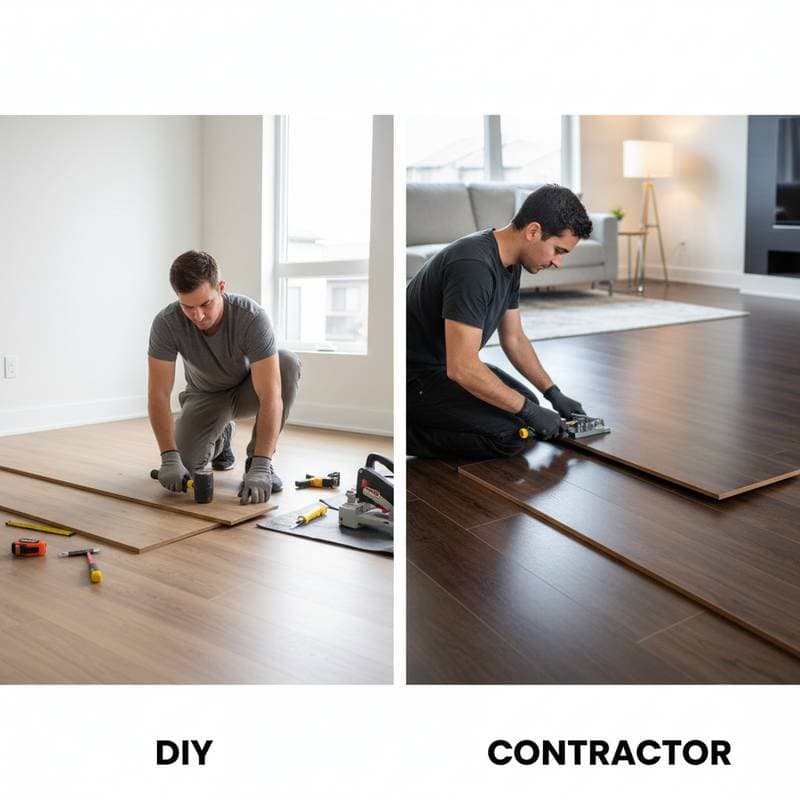
DIY LVP Installation: Weighing $1,500 Savings Against Warranty Risks
Homeowners often seek affordable ways to achieve the elegance of hardwood floors. Luxury vinyl plank flooring provides that aesthetic with greater durability and lower maintenance. The decision between DIY installation and professional service hinges on balancing significant cost savings with potential risks to quality, longevity, and warranty coverage. This guide examines those tradeoffs to help determine the best approach for specific projects.
What Luxury Vinyl Plank Flooring Entails
Luxury vinyl plank flooring features a rigid core for stability, a high-resolution printed layer that mimics wood grains, and a clear wear layer that withstands daily wear, scratches, and moisture. Planks interlock via a tongue-and-groove mechanism, which avoids adhesives or fasteners in most cases. Videos make the process appear straightforward, yet achieving a seamless finish requires attention to subfloor preparation, precise cuts, and consistent pressure during assembly. Amateur errors, such as inadequate leveling or rushed acclimation, can result in visible imperfections or premature failure.
Breaking Down Installation Costs
DIY installation of luxury vinyl plank flooring ranges from $2 to $4 per square foot, factoring in materials and basic underlayment. Professional services add $3 to $5 per square foot for labor, elevating the total to $6 to $9 per square foot. In a 500-square-foot area, this translates to savings of $1,500 to $2,500 through self-installation.
Professionals incorporate essential preparatory work, including subfloor inspection for moisture and leveling, along with accurate cuts for obstacles like door jambs. Overlooking these elements in a DIY effort may lead to issues such as plank shifting or delamination, necessitating repairs that exceed initial savings.
| Category | DIY Installation | Professional Installation |
|---|---|---|
| Average Cost per Sq. Ft. | $2 - $4 | $6 - $9 |
| Time for 300 Sq. Ft. | 1 weekend | 1 day |
| Required Skill Level | Intermediate | Expert |
| Warranty Implications | Potential void if guidelines not followed | Full coverage assured |
| Resulting Finish | Solid with careful execution | Uniformly superior |
| Potential Extra Expenses | Tool purchases, material waste, error fixes | Included in service fee |
Benefits of Handling Installation Yourself
Self-installation empowers homeowners to dictate timelines and personalize details, such as custom angles for room transitions. This method suits weekend warriors who enjoy hands-on tasks and seek to minimize expenses in phased renovations.
Projects in compact areas, like a home office or guest bedroom, benefit most from DIY approaches, as flaws remain less noticeable. Individuals with existing tools, including a fine-tooth saw, pull bar, and mallet, further reduce costs. For those testing renovation skills without committing to large outlays, this option yields professional-grade visuals at a fraction of hired rates.
Advantages of Professional Expertise
Experienced installers employ tools like digital moisture detectors and precision straightedges to verify subfloor conditions and ensure plank alignment. These measures prevent cumulative errors that widen into gaps or waves over expansive floors.
Certification from manufacturers preserves warranty validity, which often demands documented professional work for claims involving defects or environmental damage. Such safeguards prove essential in unforeseen scenarios, like flooding or heavy foot traffic.
Installers also excel at integrating edges with adjacent surfaces, such as thresholds to hardwood or metal strips for stairs. These refinements elevate the floor from functional to a cohesive design element.
Essential Steps for Effective DIY Installation
Approach luxury vinyl plank installation as a methodical sequence to maximize success. Follow this structured process for optimal outcomes.
-
Assess Subfloor Conditions
Verify cleanliness, dryness, and flatness, allowing no more than 3/16 inch deviation over 10 feet. Address dips with self-leveling underlayment to prevent locking failures. -
Assemble Tools and Supplies
Secure a sharp utility knife for trimming, a tapping block for alignments, spacers for gaps, a jigsaw for curves, and a tape measure for accuracy. Allocate 10 percent additional planks for cuts and errors. -
Allow Acclimation Time
Position unopened packages in the installation area for 48 hours minimum, enabling adjustment to local humidity and temperature variations. -
Design the Pattern
Begin installation parallel to the longest continuous wall, offsetting joints by 6 to 8 inches across rows to distribute seams evenly and enhance realism over straight-line repetitions. -
Execute the Assembly
Engage each plank with steady, even force, employing the tapping block to close joints without damaging edges. Maintain a 1/4-inch perimeter gap to accommodate natural expansion. -
Complete the Edges
Secure baseboards or install quarter-round molding to conceal gaps. Conduct a thorough cleaning and check all connections for tightness before foot traffic.
Addressing Frequent DIY Hurdles
Gaps emerging between planks weeks post-installation typically stem from poor acclimation or environmental shifts. Apply controlled heat from a utility gun to soften the material, then realign with gentle tapping.
Peaking or buckling arises from omitted expansion spaces. Disassemble affected sections, reestablish proper clearances, and monitor humidity levels to stabilize the floor.
Prominent seams often indicate subfloor irregularities. Sand high spots or apply patching compounds prior to retrying, ensuring a smoother base for future efforts.
Scenarios Favoring Professional Involvement
Opt for experts in multifaceted projects spanning hallways, multiple levels, or varied flooring types, where precision alignment proves challenging. Rectifying errors in such setups often incurs higher costs than upfront professional fees.
In moisture-prone zones, such as below-grade spaces or utility areas, pros select appropriate barriers and ventilation products to mitigate risks of adhesion failure or microbial growth. Their assessments identify hidden issues, like latent dampness, that DIY checks might overlook.
Ensuring Durability Through Care
Luxury vinyl plank flooring demands simple routines for sustained performance. Sweep debris regularly and mop with a diluted solution to preserve the surface sheen. Steer clear of abrasive cleaners that erode the protective layer.
Expect lifespans of 15 to 25 years, influenced by traffic volume and layer thickness. For self-installed floors, inspect joints quarterly in the initial period to catch and correct minor shifts proactively.
Professionally laid floors often come with added assurances, including labor guarantees that address settling or adhesion concerns within the first year.
Maximizing Your Flooring Investment
Selecting between DIY and professional installation depends on project scale, personal expertise, and tolerance for potential imperfections. Savings from self-work appeal to skilled enthusiasts, while pros deliver reliability for demanding applications. Either choice enhances home value when executed with care, providing enduring style and functionality.