
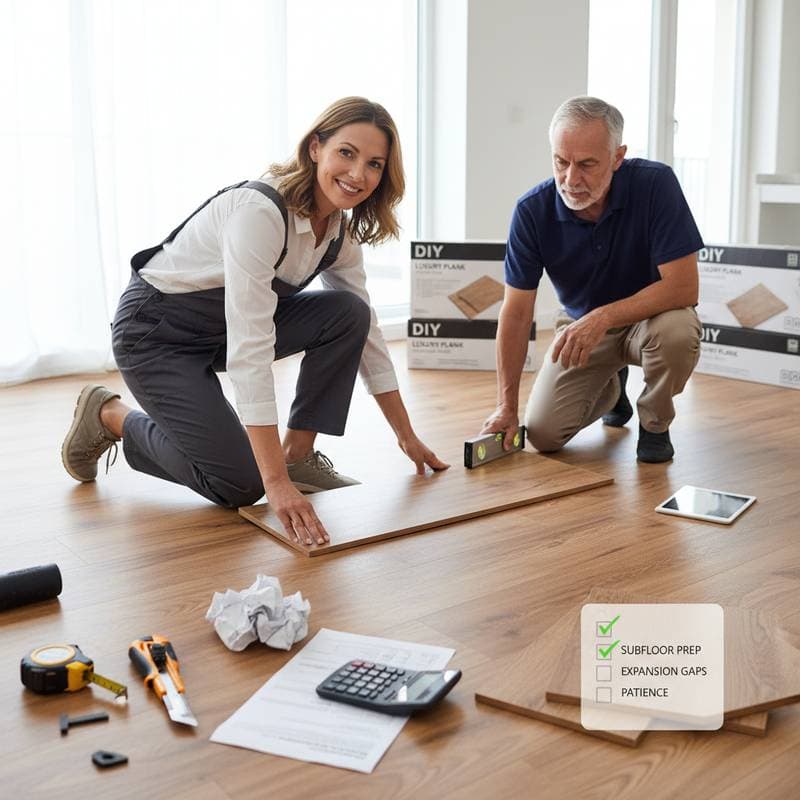
Understanding the DIY Success Rate for Luxury Vinyl Plank Flooring
Homeowners often envision transforming their spaces with luxury vinyl plank flooring, drawn to its wood-like appearance and straightforward click-lock system. This material delivers a high-end look without requiring advanced skills, yet the outcome relies heavily on thorough preparation and precise installation techniques. Industry surveys reveal that 70 to 80 percent of DIY projects achieve long-term durability, free from common problems such as warping or gaps.
Success in this context means creating a level, seamless surface that withstands daily use for years. Factors like subfloor condition and installer experience play crucial roles. Those who invest time in planning report fewer complications and greater satisfaction with the final appearance.
Defining Success in LVP Installations
A successful installation produces a floor that remains flat and intact over time, resisting moisture, temperature shifts, and foot traffic. Contractors and user feedback consistently show that 70 to 80 percent of DIY efforts meet these standards when basic guidelines are followed. The other 20 to 30 percent typically suffer from overlooked steps, such as inadequate leveling or rushed cutting.
Individuals with prior experience in home projects fare better, as they recognize the importance of a stable base. Beginners benefit from starting small to build confidence. Overall, the forgiving nature of LVP contributes to its high DIY viability compared to hardwood or tile.
Comparing Costs: DIY Versus Professional Services
Budget considerations drive many flooring choices, and LVP installation highlights clear financial differences. Hiring a professional adds $2 to $4 per square foot in labor fees, varying by location and room layout. For a 500-square-foot area, this translates to $1,000 to $2,000, excluding materials.
DIY approaches eliminate labor expenses, though tool and accessory costs arise. Essential items include underlayment at $0.20 to $0.50 per square foot, trim pieces, 1/4-inch spacers, a tapping block, and a fine-tooth saw, totaling $100 to $250 for newcomers. These investments yield substantial savings, often 50 to 70 percent of professional totals, while fostering a sense of accomplishment.
Homeowners must factor in time, which can span a weekend for average rooms. The economic advantage grows for larger projects, but quality hinges on execution rather than cost alone.
Identifying Common Installation Challenges
Even seasoned DIY enthusiasts encounter hurdles that undermine LVP projects. Addressing these proactively raises the odds of joining the successful majority.
-
Inadequate Subfloor Preparation: The surface must be flat within 3/16 inch over 10 feet, clean, and dry. Minor imperfections lead to plank separation or visible irregularities.
-
Neglecting Expansion Gaps: Maintain a 1/4-inch gap around the perimeter to allow for natural movement. Omitting this invites buckling during seasonal humidity changes.
-
Imprecise Layout Planning: Begin with a straight reference line using a chalk line to ensure rows remain square. Deviations result in gapped or uneven wall cuts.
-
Overlooking Acclimation Period: Allow planks to sit in the installation room for 48 hours at stable temperature and humidity. Skipping this step causes post-installation shifts.
These issues often stem from haste, but simple checks prevent most failures.
Assessing Skills and Project Suitability
LVP installation demands basic abilities like accurate measuring and straight cutting, rating as moderate difficulty for most. The interlocking mechanism simplifies assembly, yet methodical pacing ensures tight fits. Confident users handle tools such as miter saws without issue.
Ideal starter projects include compact areas like bedrooms or hallways under 200 square feet. Expansive or irregular spaces, such as kitchens with islands, suit those with assistance or professional input. A hybrid method—self-installing simple sections while outsourcing complex ones—optimizes results and budget.
Experience levels correlate directly with outcomes; practice on scrap pieces builds proficiency quickly.
Essential Preparation and Safety Measures
Preparation begins with precise room measurements, purchasing 10 to 15 percent extra material for cuts and errors. Remove baseboards if needed, and inspect for moisture levels below 65 percent relative humidity. Level the subfloor using self-leveling compound for dips exceeding 1/8 inch.
Safety protocols protect against hazards during the process. Wear knee pads to ease prolonged kneeling, safety glasses for cutting, and a dust mask in well-ventilated areas. When removing existing floors, test for asbestos in pre-1980s homes and dispose of debris properly.
These steps create a controlled environment, minimizing risks and enhancing efficiency.
Expert Strategies for Flawless Execution
To maximize success, incorporate these targeted techniques throughout the project.
-
Test Layout in Advance: Dry-fit several rows to verify alignment and identify adjustments early.
-
Secure Connections Methodically: Tap planks firmly with a mallet and block, checking for clicks at every joint, particularly in high-traffic zones.
-
Monitor Progress Continuously: Pause to examine rows for levelness and gaps, correcting issues before advancing.
-
Maintain Cleanliness: Vacuum frequently to remove debris that could disrupt plank seating.
Additional aids, like a pull bar for tight spaces, streamline challenging areas.
Ensuring Durability and Enjoyment Post-Installation
After completion, avoid heavy traffic for 24 hours to allow settling. Clean with a damp mop using pH-neutral solutions, steering clear of abrasives. Regular maintenance preserves the floor's luster and prevents wear.
A well-executed DIY LVP installation elevates home aesthetics and value, delivering resilience against everyday demands. By prioritizing preparation and precision, homeowners secure results that rival professional work, fostering lasting pride in their craftsmanship.