
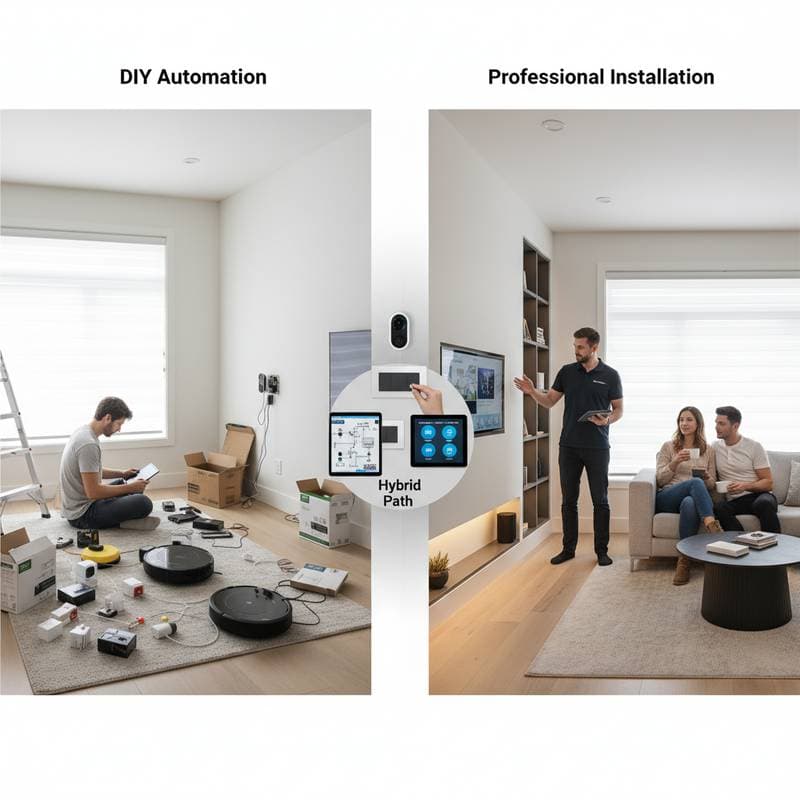
Comparing DIY and Professional Smart Home Approaches: Balancing Effort and Expertise
If your lights respond to voice commands only intermittently or your thermostat resets unexpectedly, you have likely questioned the value of managing your own smart home setup. Perhaps you experienced satisfaction from linking your initial smart plug, but the prospect of installing a wired smart doorbell now seems daunting. Numerous homeowners reach this juncture and must choose between persisting with self-directed installations or engaging a specialist.
Smart home systems deliver convenience, reduced energy consumption, and modern enhancements. However, as technology grows more intricate, the decision emerges: continue with personal adjustments or delegate to an experienced professional who handles such tasks routinely?
Advantages and Challenges of the DIY Approach: Emphasizing Savings and Autonomy
Unboxing a new device, scanning its QR code, and observing it integrate into your living space provides a sense of accomplishment. Opting for DIY smart home installations typically reduces initial expenses considerably. For instance, a basic smart switch ranges from 30 to 60 dollars, whereas professional labor might add 100 to 200 dollars per unit.
Benefits of DIY smart home installation:
- Reduced expenses: Cover solely the cost of hardware, excluding service fees.
- Complete oversight: Select integration methods and preferred platforms independently.
- Skill development: Each installation enhances technical proficiency and self-assurance.
- Adaptable growth: Introduce components incrementally, aligned with financial capacity.
Drawbacks of DIY smart home installation:
- Significant time investment: Configuration and issue resolution may consume several hours per device.
- Technical demands: Certain setups necessitate proficiency in networking or electrical systems.
- Warranty restrictions: Support from manufacturers frequently disregards problems stemming from faulty assembly.
A comprehensive DIY configuration for a modest residence generally totals 500 to 1500 dollars, varying by device quantity. Beyond monetary outlay, the primary concealed cost involves time allocation. Coordinating various units, aligning applications, and addressing software updates can occupy full weekends, potentially leading to frustration if compatibility issues arise.
To mitigate these challenges, research device specifications thoroughly before purchase. For example, verify compatibility with your existing router or hub to prevent integration failures. This preparation transforms potential setbacks into manageable steps.
Prioritizing Safety and Security in Smart Home Setups
The security of a smart home hinges on its most vulnerable component. Faulty wiring, inadequate Wi-Fi safeguards, or unsecured gadgets pose genuine hazards, including electrical risks or data breaches. During self-installation, adhere to these essential practices:
- Deactivate electricity at the main breaker prior to modifying switches or outlets.
- Employ surge protectors for central hubs and network equipment.
- Establish distinct, robust passwords for individual devices and the overall Wi-Fi.
- Regularly update firmware to address known security flaws.
Should electrical modifications or wall penetrations for surveillance cameras exceed your comfort level, consult a certified installer. Professionals possess liability coverage and adhere to regional building regulations, minimizing liability and ensuring long-term functionality. In regions with stringent codes, such as those mandating GFCI outlets in wet areas, expert involvement prevents costly rework.
Consider conducting a home audit first: map out electrical panels and Wi-Fi dead zones to identify potential pitfalls early. This proactive measure not only bolsters safety but also informs whether DIY remains feasible.
Strategies for Effective DIY Implementation
For those inclined toward self-installation, begin modestly by focusing on a single area or device category, such as automating lighting in the living room. Initially, commit to a unified brand or platform, like Philips Hue or Google Nest, to sidestep interoperability complications. Within applications, assign clear labels to each device, facilitating swift identification during diagnostics.
Furthermore, prioritize a robust Wi-Fi infrastructure, such as a mesh network covering 2000 square feet, to eliminate signal interruptions. Test connections post-installation by simulating daily routines, like remote access from outside the home. If persistent glitches occur, document error messages for targeted online research or community forums.
Document your setup process with photographs of wiring and configurations. This record proves invaluable for future expansions or when seeking manufacturer assistance, streamlining resolutions.
Integrating Professional Expertise for Optimal Results
A thoughtfully designed smart home, whether assembled personally or with professional aid, simplifies daily routines rather than complicating them. Envision automated lighting adjustments for evening relaxation, precise temperature controls upon departure, and timed appliance activation for morning efficiency.
When DIY efforts falter, professionals excel in customizing systems to unique layouts, such as integrating voice assistants with legacy wiring in older homes. Hybrid models prove popular: handle basic plugs and bulbs independently while outsourcing advanced features like whole-home audio or security automation. This combination yields cost efficiency without sacrificing performance.
Ultimately, assess your technical aptitude and project scope honestly. By selecting the appropriate blend of self-reliance and expert input, you secure a smart home that enhances comfort and security enduringly.