
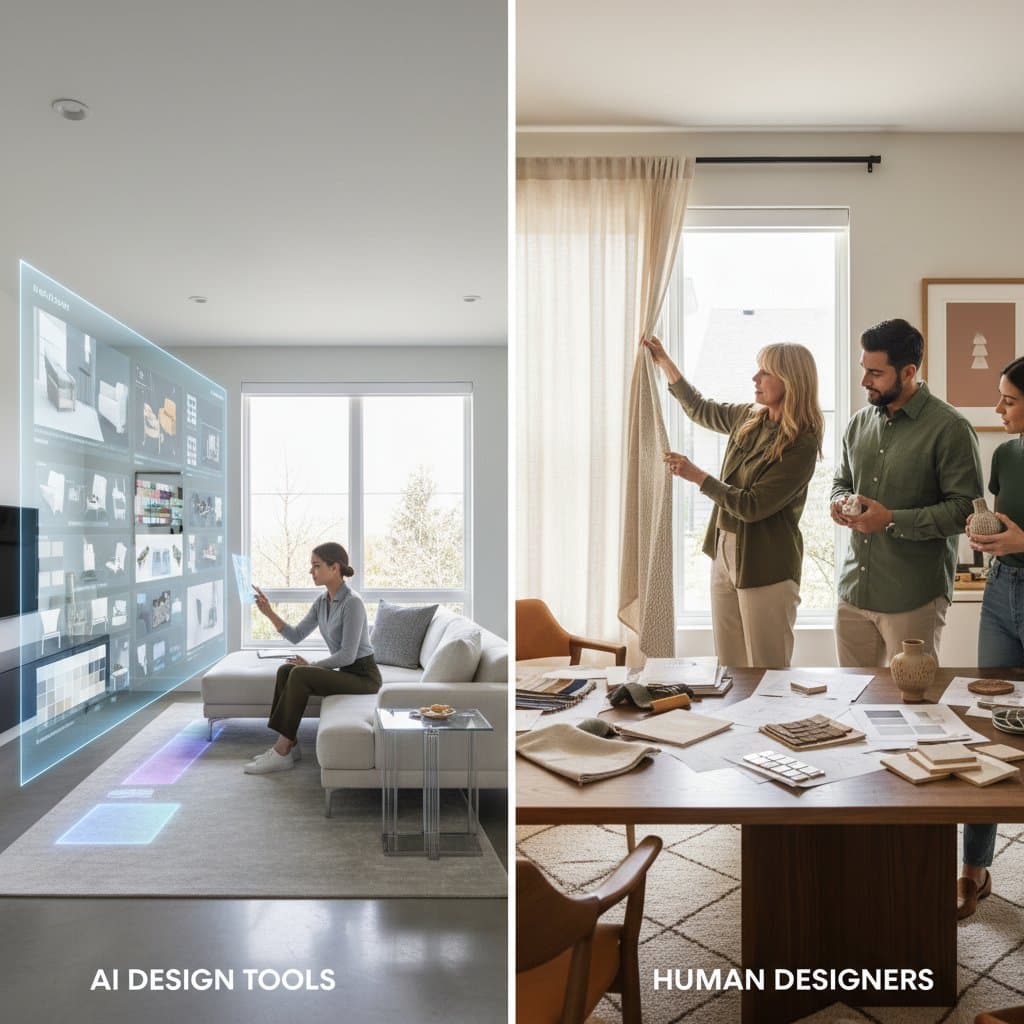
AI Design Tools Versus Human Designers: The Smart Choice for 2025 Home Upgrades
Homeowners often gaze at their living rooms and sense that the space lacks warmth or functionality. This common frustration highlights the tension between achieving a professional look and managing costs. AI design tools now offer a solution with rapid, affordable visualizations, yet they prompt a key question: can algorithms truly capture the nuances of personal style and daily life that a human designer intuitively grasps?
The decision between AI-assisted design and expert human input grows more relevant as 2025 nears. Each method brings distinct benefits, shaped by individual budgets, project scopes, and visions for the home. Understanding these options empowers homeowners to select the approach that aligns with their needs.
Scenarios Where AI Design Tools Excel
AI platforms perform exceptionally in projects of modest scale, particularly when users possess a basic understanding of their preferences. These tools facilitate visualization without the need for appointments, making them suitable for:
- Quick updates to spaces like home offices or guest bedrooms, where users experiment with color palettes and layouts in minutes.
- Rental properties requiring a cohesive aesthetic on a tight budget, such as selecting neutral tones and modular furniture arrangements.
- Cost-effective transformations that repurpose current items, like rearranging existing sofas and adding affordable wall art.
For individuals comfortable with technology, AI provides autonomy and immediate results. Users input room dimensions, preferred styles, and even natural light patterns to generate realistic renders. This process minimizes errors, such as mismatched scales or clashing hues, by simulating spatial dynamics. However, advanced algorithms cannot fully replicate sensory elements like fabric feel or ambient mood.
Integrating AI and Human Expertise for Optimal Results
Homeowners need not select exclusively between AI and human designers. A blended strategy often yields superior outcomes, starting with AI for ideation and transitioning to professional input for polish. Begin by generating multiple concepts through an AI tool, then share these visuals with a designer to incorporate practical adjustments.
Forward-thinking designers increasingly incorporate AI into their workflows. They enter client details, such as family size and hobby spaces, to produce preliminary sketches. Refinements follow, drawing on the designer's knowledge of material sourcing, ergonomic principles, and long-term durability. This collaboration enhances efficiency while preserving creative depth.
For renovations involving alterations like wall removals or custom cabinetry, the hybrid model proves essential. AI handles exploratory phases, while experts manage permits, vendor coordination, and on-site adaptations. In simpler cases, such as seasonal decor shifts, AI dominates with occasional designer reviews for cohesion.
Addressing Safety, Quality, and Practical Constraints
Home improvements extend beyond aesthetics to encompass structural and safety considerations. AI suggestions for furniture placement or lighting may overlook critical factors, including load-bearing walls or electrical standards. Professionals must evaluate these elements to prevent hazards and ensure compliance with building codes.
Digital previews, though impressive, sometimes misrepresent physical outcomes. Variations in natural light, material sheen under different conditions, or actual room acoustics can alter the final effect. Experienced designers identify these discrepancies early, recommending alternatives like matte finishes for high-traffic areas or sound-absorbing rugs for open layouts.
Quality control remains a human domain. Designers assess supplier reliability, warranty details, and installation techniques to avoid subpar results. Relying solely on AI risks overlooked issues, such as incompatible fixtures that lead to rework and added expenses.
Experiencing Design in Daily Life
The true measure of a design emerges through everyday use. Spaces must support routines, from family gatherings to quiet evenings, fostering comfort and joy. Human designers excel here by considering emotional responses, such as how a cozy nook encourages relaxation or vibrant accents boost energy.
AI generates functional plans based on data inputs but lacks insight into subtle preferences, like a preference for soft lighting during winter months. Over time, users may find AI-suggested designs feel impersonal, requiring tweaks to align with evolving needs. Designers anticipate these shifts, creating adaptable environments that age gracefully.
Steps to Implement Your 2025 Home Design Plan
Start by assessing your project's scope: identify must-have changes, budget limits, and timeline constraints. Research AI tools that offer free trials, focusing on those with user-friendly interfaces and accurate rendering capabilities. Generate several options, noting which resonate most with your lifestyle.
Next, consult a certified interior designer through professional networks or local associations. Present your AI concepts for feedback, prioritizing those experienced in technology integration. Discuss costs upfront, including hourly rates or project fees, to refine your approach.
Execute in phases: test small AI-driven updates first, like a bedroom refresh, before scaling to larger areas. Monitor the results, adjusting based on real-world feedback. This methodical process ensures a tailored, enduring upgrade that enhances your home for years ahead.