
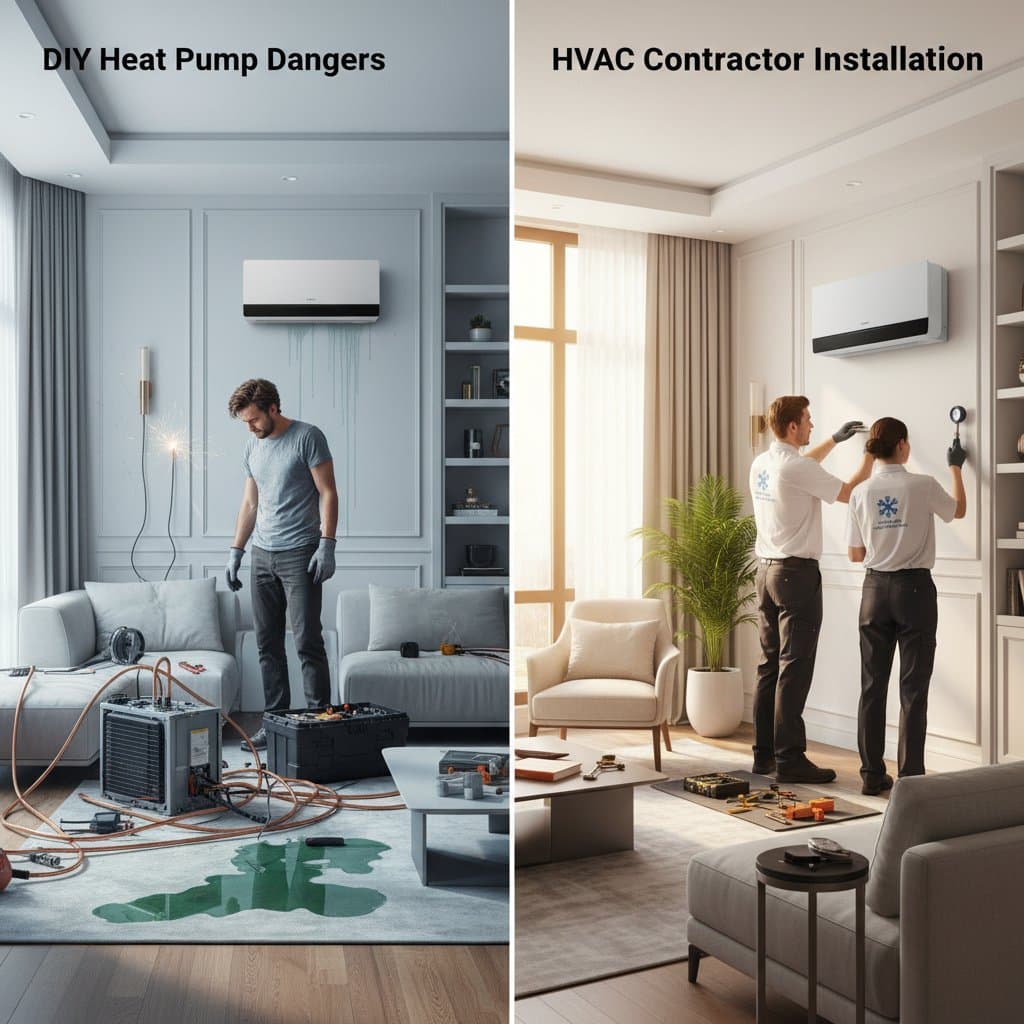
The Risks of DIY Heat Pump Installation: Safeguarding Your Home and Finances
Homeowners often examine escalating energy expenses and consider installing a heat pump independently. Instructional videos portray the task as straightforward, featuring an external unit, refrigerant connections, and immediate enhancements in comfort and efficiency. However, these resources overlook critical details: a minor error can trigger substantial repair expenses, nullify manufacturer guarantees, and introduce persistent safety concerns. Heat pump systems integrate intricate mechanical, electrical, and refrigerant elements that necessitate expert handling for optimal results.
Understanding the Appeal of Self-Installation
The drive to install a heat pump without assistance stems from clear incentives. These systems deliver reduced utility bills and consistent indoor temperatures throughout the seasons. Bypassing installer fees appears as a direct path to financial relief, particularly with online vendors offering complete kits equipped with adaptable lines and simple connectors labeled as user-friendly options. Individuals experienced in basic repairs, such as swapping plumbing fixtures or lighting, may feel adequately prepared.
Nevertheless, heat pumps demand precision beyond basic assembly. Installers must maintain specific refrigerant pressures, balance electrical loads accurately, and seal connections without gaps. Any deviation risks diminishing operational effectiveness or generating concealed dangers.
Unseen Complexities in Heat Pump Systems
A heat pump seems uncomplicated at initial inspection: an external compressor unit, internal air distribution component, and linking conduits. In reality, all parts require seamless coordination to achieve safe and efficient function.
Trained specialists employ tools such as vacuum apparatuses, pressure gauges, and precision meters to calibrate the refrigerant circuit. They compute conduit lengths, height variations, and refrigerant quantities using equations tailored to regional weather patterns and structural layouts. An excess or deficiency in refrigerant, even minimal, accelerates compressor wear, with replacement expenses ranging from $1,200 to $3,000.
Comparing Costs: Self-Installation Versus Expert Service
Self-installation attracts attention through upfront cost reductions. For a standard residence, a complete heat pump setup, including labor, ranges from $4,000 to $8,000. Acquiring components alone and performing the work might limit outlays to $2,500 through $5,000.
Subsequent expenses reveal the full picture. Faulty setup contributes to several issues:
- Decreased performance: Potential 30 percent rise in energy use due to improper refrigerant or restricted air movement
- Diminished durability: Units expected to endure 15 years may malfunction within seven or eight
- Guarantee invalidation: Producers typically mandate verified professional work for coverage eligibility
- Remediation fees: Correcting errors often exceeds original professional charges
Frequently, owners hire experts to rectify problems, elevating total expenditures beyond initial professional quotes.
Overlooked Safety Hazards
Financial implications aside, safety represents the paramount issue. Heat pumps incorporate high-voltage wiring, pressurized refrigerants, and tensioned mechanisms that pose threats absent qualified oversight. Refrigerants function as dense fluids capable of oxygen displacement in enclosed areas, alongside risks of severe cold injuries or corrosive contact upon exposure.
Faulty wiring introduces ignition possibilities. These systems need isolated circuits matched to precise current capacities; mismatches strain protective devices or impair control panels. Certified HVAC professionals adhere to regional regulations, mitigating such perils through standardized practices.
Refrigerant Management and Required Certifications
Handling refrigerants sharply distinguishes expert from amateur efforts. Regulations in numerous areas demand certification for acquiring, processing, or discarding these substances. Such measures extend beyond administrative requirements to shield residents and ecosystems from emissions that harm atmospheric conditions.
Minor escapes erode efficiency and disperse pollutants. Identifying these requires equipment sensitive to minute pressure variations, often under one pound per square inch. Approximating procedures invites contamination or permanent harm to components.
Debunking Claims of User-Friendly Heat Pump Models
Certain manufacturers promote models as accessible for self-setup, featuring pre-filled conduits for ease. Despite appearances, challenges persist. Connections demand perfection to prevent escapes, and evacuation processes remove contaminants like air and humidity.
Failure to purge adequately initiates internal deterioration, causing capacity loss and coil icing. Accompanying warnings state that alterations or flawed joins eliminate warranty protections. Initial cost advantages dissolve into demonstrations of professional necessity.
Essential Reasons to Engage Professionals
Pursuing enhanced energy use warrants selecting a credentialed specialist as a protective measure. Experts conduct capacity assessments to select appropriate unit dimensions, an omission common in self-efforts. Excessively large systems cycle inefficiently, accelerating degradation and power waste; undersized variants operate nonstop without achieving desired climates.
Qualified personnel confirm adherence to ordinances, secure approvals, and assess electrical infrastructure compatibility. They validate air circulation, refrigerant volumes, and operational controls prior to completion. These procedures distinguish dependable outcomes from hazardous trials.
Realizing Enduring Benefits from Expert Setup
View professional involvement as a commitment to superior function and tranquility. Skilled providers adapt systems to unique property traits, such as barrier effectiveness, ventilation configurations, and local meteorology. This tailoring yields annual reductions in energy outlays amounting to several hundred dollars.
Numerous specialists provide upkeep agreements encompassing routine evaluations and adjustments. These initiatives detect minor faults early, prolonging service life and upholding guarantee terms. Across ten years, an optimized and serviced unit conserves thousands relative to flawed alternatives.
Promoting Sustainability Through Proper Installation
Errors in self-setup extend beyond personal finances to environmental impacts. Imbalanced refrigerant or airflow elevates power demands, negating efficiency gains. Escapes emit potent climate agents, while suboptimal performance burdens energy sources, amplifying collective outputs.
Opting for experts fosters ecological goals by guaranteeing maximal operation. Various locales provide financial aids for certified efficient installations, offsetting preliminary investments.
Indicators of Substandard Self-Installation
For those who have undertaken self-work or acquired properties with uncertain systems, observe these alerts:
- Inconsistent temperatures across spaces
- Unexplained increases in utility charges
- Ice accumulation on external elements
- Unusual noises from connection areas
- Recurrent halts or diagnostic alerts
Upon detecting such signals, arrange an expert review promptly. Timely fixes avert escalation and reinstate optimal function.
Practical Guidance for Homeowner Participation
To incorporate personal efforts securely, collaborate with professionals in non-technical areas. Consider these approaches:
- Prepare the site: Remove obstacles, stabilize bases, and route basic wiring as directed.
- Perform routine care: Refresh filters, clear external debris, and adjust controls independently.
- Request demonstrations: Gain explanations of elements and usage techniques from installers.
- Organize records: Retain guides, assurances, and logs for ongoing management.
This involvement fulfills practical interests while delegating vital tasks appropriately.
Ensuring Ongoing System Performance
Following professional placement, regular attention sustains efficiency. Exchange filters monthly to quarterly, maintain clear access around external units, and book annual expert checks. These sessions verify refrigerant integrity, wiring security, and surface cleanliness.
Address deviations in consumption or climate control without delay. Proactive measures avert deterioration and sustain protections. Regard the heat pump as a durable resource to secure sustained advantages in comfort and economy.