
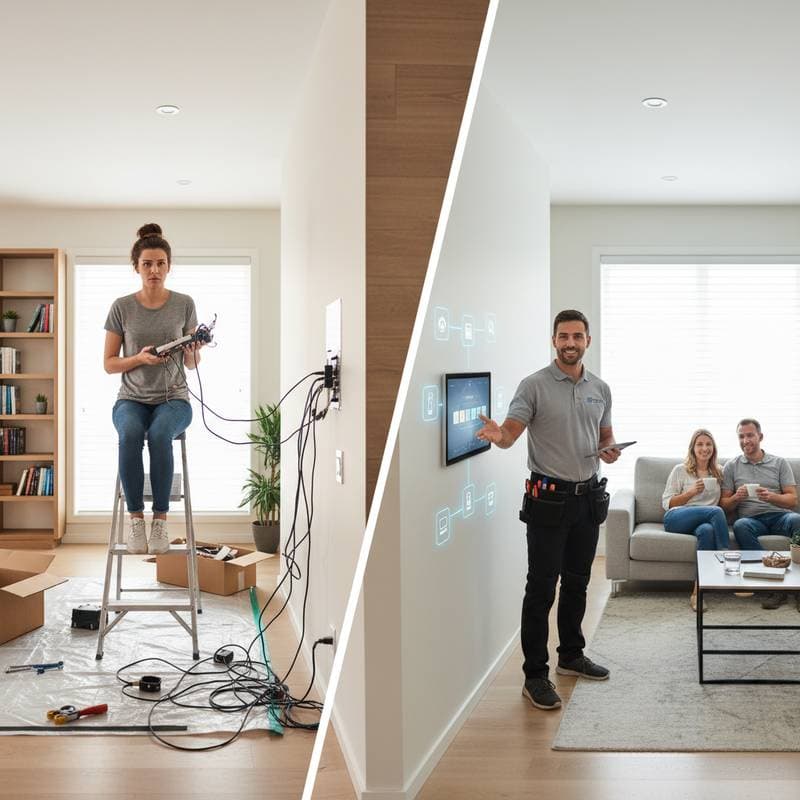
DIY Smart Home: When to Go Pro for Seamless Setup
Picture a Saturday afternoon devoted to disentangling smart plugs, linking hubs partially, and confronting LED lights that fail to synchronize. Such scenarios illustrate how a DIY smart home endeavor can evolve from enthusiasm to exasperation. Automation and ease promise much, yet the route demands careful planning. Success depends on discerning personal capabilities from the need for certified expertise.
This resource delineates strategic approaches to smart home initiatives, spanning initial configurations to sustained upkeep. Upon completion, readers possess a structured method for selecting solo projects against those necessitating professional intervention to yield a fluid, integrated system.
The DIY Advantage
Independent smart home projects attract participants through valid merits. They permit modest beginnings, technological exploration, and gradual refinements without substantial monetary outlay. Contemporary devices frequently incorporate intuitive applications that direct installations progressively.
Benefits of DIY Installation
- Budget control: Eliminate labor fees, typically spanning $50 to $150 hourly by location and system variety.
- Flexibility: Proceed at preferred speed, evaluating diverse products as requirements change.
- Learning opportunity: Acquire comprehensive insight into system functions, aiding future diagnostics.
Ideal DIY Projects
- Smart plugs, bulbs, and switches linking directly to Wi-Fi networks.
- Smart speakers or displays serving as primary hubs.
- Video doorbells utilizing pre-existing wiring.
- Smart thermostats suited to straightforward wiring arrangements.
Homeowners generally complete these tasks within one to two hours using basic implements. A screwdriver, voltage tester, and mobile application suffice in most instances.
Cost Comparison: DIY vs. Professional Setup
Grasping expense structures informs prudent decisions. Although DIY appears economical at outset, errors or partial implementations may incur subsequent costs.
| Installation Type | DIY Estimated Cost | Professional Estimated Cost | Skill Level Required | Risk Level |
|---|---|---|---|---|
| Smart bulbs and plugs | $20 to $100 per room | $100 to $200 total | Beginner | Low |
| Smart thermostat | $150 to $300 | $250 to $500 | Intermediate | Medium |
| Security system | $200 to $400 | $500 to $1,200 | Intermediate to Advanced | Medium to High |
| Whole-home automation | $600 to $1,200 | $1,500 to $5,000+ | Advanced | High |
Expert services encompass network enhancements, cable organization, and device tuning for enduring performance. Independent efforts, though less costly, demand continual oversight and issue resolution.
Troubleshooting Common DIY Issues
Basic setups occasionally encounter obstacles. The following addresses prevalent challenges with resolution steps.
Connectivity Failures
Devices disconnecting from networks signal weak Wi-Fi coverage at the site. Install a range extender or mesh router component to fortify the connection. Measure signal intensity using application tools prior to placement.
App Sync Problems
Restart the device alongside its application. Certain systems mandate firmware refreshes prior to linkage. Perform all available updates before initiating pairing processes.
Voice Control Errors
Non-responsive assistants stem from misassigned identifiers. Assign concise labels such as "Living Room Lamp" within the application settings. Avoid extended descriptors to minimize recognition failures.
Power Supply Issues
Failure to activate indicates outlet or switch verification needs. For wired units, ensure the circuit breaker engages and connections secure. Employ a multimeter to confirm voltage presence.
Safety and Compliance Considerations
Smart home integrations may align with construction regulations and insurer stipulations. Hardwired cameras or locks often require adherence to locale-specific norms. Review electrical guidelines before altering circuits.
Trained specialists possess coverage and expertise in regulatory adherence. Engaging them for intricate tasks safeguards assets and upholds manufacturer guarantees.
Long-Term Maintenance and Upgrades
Technology in this domain advances rapidly, necessitating software renewals and component substitutions. Establish a routine for firmware checks and monthly automation verifications to maintain efficiency.
Systems spanning brands or interfaces benefit from recorded configurations and settings. Such documentation expedites recovery during resets or replacements.
Specialists offer upkeep plans featuring regular evaluations and enhancements. Annual fees range from $100 to $300 based on scale, prolonging equipment durability through precise adjustments.
Pro Tips for Success
- Initiate modestly to cultivate assurance before broader implementations.
- Label wiring and record configurations amid setups.
- Acquire surge safeguards or reserve power sources for essential elements like surveillance and temperature regulation.
- Implement robust, distinct passwords alongside two-factor verification in applications.
- Evaluate routines periodically to align with evolving habits.
Achieving a Reliable Smart Home Integration
Integrate these insights to construct a system that enhances daily life without undue complication. Professionals bridge gaps in expertise, ensuring installations endure and perform consistently. Balance independent efforts with expert support to realize a connected residence that adapts seamlessly to needs.