
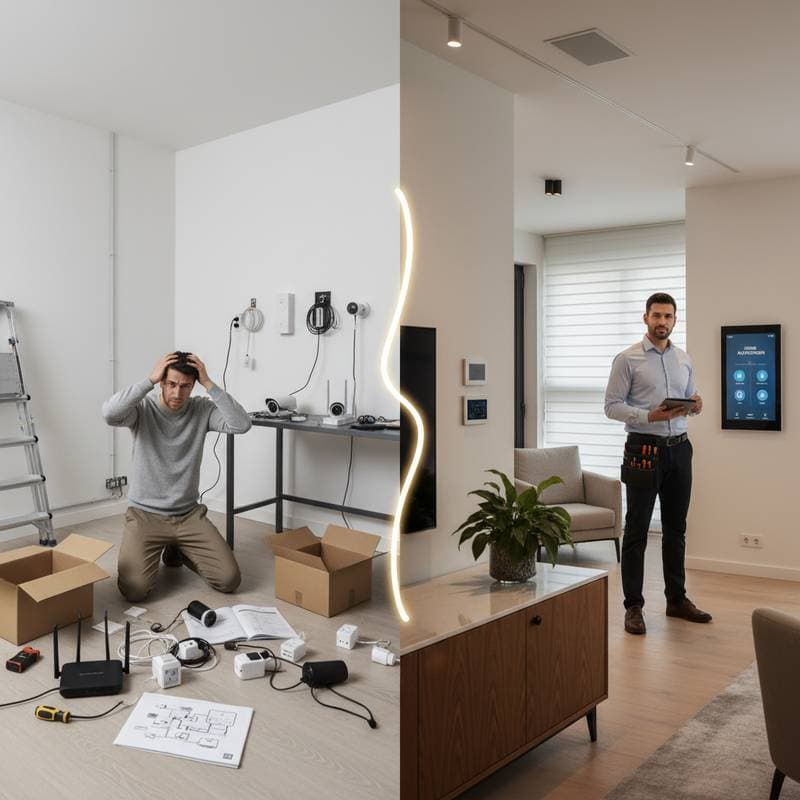
DIY vs Professional: Choosing Your Smart Home Setup
Imagine entering a living room where smart bulbs illuminate softly as you arrive, and the thermostat adjusts to your preferred temperature without effort. This seamless experience defines a modern smart home, yet achieving it requires a key decision: handle the installation yourself or hire a professional. Factors such as your technical skills, financial resources, and available time will guide this choice toward a system that enhances daily life effectively.
Benefits of DIY Smart Home Installation
Homeowners often select the do-it-yourself approach for the autonomy it provides. Begin with basic components, such as a smart plug or security camera, and gradually incorporate additional elements. Contemporary devices feature user-friendly mobile applications, compatibility with voice assistants, and detailed instructional resources that simplify the process.
For individuals who appreciate tackling challenges, this method resembles an engaging project rather than an overwhelming task. Typical expenses include smart bulbs ranging from 10 to 50 dollars per unit, smart plugs between 15 and 40 dollars, and comprehensive DIY security camera packages from 100 to 300 dollars. These installations typically demand only basic tools like a screwdriver, dependable Wi-Fi, and persistence.
Opting for DIY can reduce overall expenses by up to 30 percent when compared to professional fees. It allows customization and incremental growth tailored to personal needs. However, challenges arise with system expansion; incompatibilities among different manufacturers, strained network capacity, or inconsistent voice command responses may necessitate extended problem-solving.
To mitigate these issues, seasoned users suggest initiating with a unified platform, such as Google Home, Amazon Alexa, or Apple HomeKit. This strategy promotes harmony across devices and eases management. Conduct a preliminary compatibility check using manufacturer specifications to avoid future frustrations.
Advantages of Professional Installation
Engaging a certified home automation specialist ensures a trouble-free outcome, particularly for those seeking minimal involvement. Experts craft integrated solutions encompassing lighting, climate control, media systems, and surveillance, all accessible via a single interface. They conceal wiring for aesthetic appeal, handle software updates, and fine-tune energy efficiency based on your residence's unique configuration.
Professional services yield lower malfunction rates and superior durability over time. Installers adhere to regional electrical regulations, safeguarding against potential liabilities related to insurance or property sales. Estimated pricing for complete home automation ranges from 1,500 to 5,000 dollars, with hourly labor fees of 80 to 150 dollars varying by location.
Additional packages for maintenance provide ongoing assistance, including remote diagnostics and upgrades. Professionals perform thorough assessments of your existing infrastructure, such as electrical panels and network strength, to recommend optimal device placements. This foresight prevents costly modifications and maximizes system performance from the outset.
For intricate features like automated shading or multi-zone audio, expert intervention proves invaluable. They integrate advanced protocols, ensuring scalability for future enhancements without disrupting current operations.
Striking an Effective Balance
A combined strategy suits numerous households, where straightforward elements receive personal attention and sophisticated components benefit from expert oversight. Install plug-in sensors independently while delegating tasks like centralized security networks or climate management to professionals. This method combines the fulfillment of participation with assured functionality.
Prior to commencement, assess critical aspects including Wi-Fi signal strength across rooms, availability of power sources, and interoperability among selected products. A basic walkthrough of your space identifies potential obstacles early. For exterior installations, such as weather-resistant cameras or electronic entry systems, professional handling guarantees durability and adherence to safety norms.
Consult online forums or device manuals for compatibility matrices. Budget for potential tools, like network extenders, to support robust connectivity. This preparation fosters a resilient foundation for your smart ecosystem.
Essential Strategies for Optimal Results
Develop a detailed blueprint outlining automation priorities per area and prioritizing high-impact devices, such as motion-activated lights in high-traffic zones. Evaluate options like energy-monitoring plugs to track usage patterns and identify savings opportunities.
Establish a solid internet foundation, perhaps by upgrading to mesh Wi-Fi systems that eliminate dead zones. Test signal quality in remote areas using free diagnostic apps before purchasing equipment.
Maintain meticulous records by tagging each component and securing access credentials in a centralized digital vault. Schedule periodic reviews to update firmware and reconfigure as household needs evolve.
Introduce devices incrementally; monitor performance after each addition to detect bottlenecks promptly. If issues persist, consult manufacturer support channels or community resources for targeted solutions.
Realizing Everyday Enhancements
With connections established, your smart home operates intuitively: illumination syncs with occupancy, entertainment transitions smoothly between spaces, and resource consumption optimizes automatically. This setup, whether self-assembled or professionally orchestrated, integrates unobtrusively to elevate security, efficiency, and comfort in routine activities.