
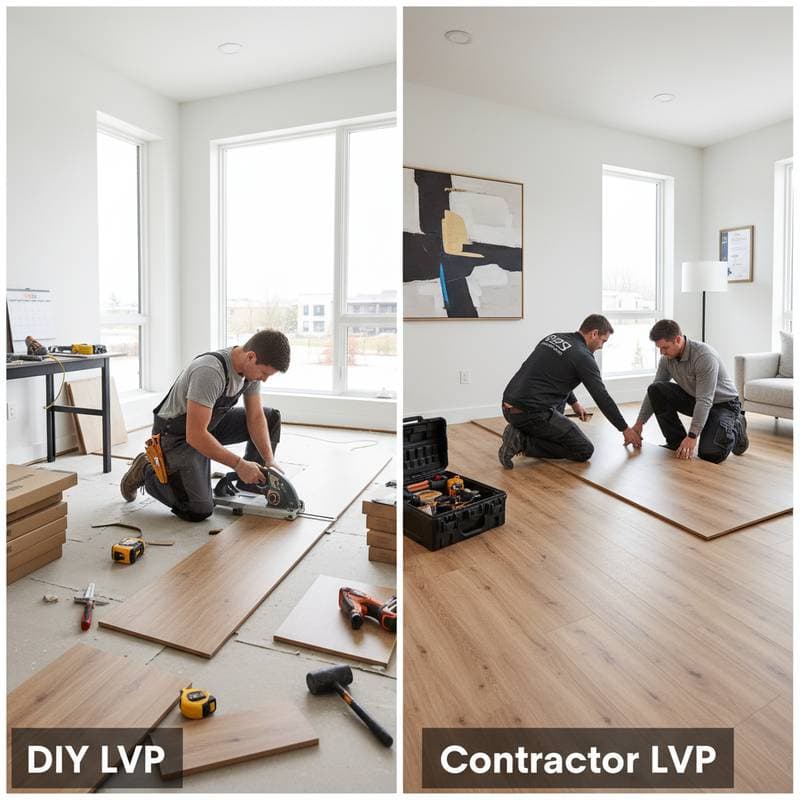
DIY vs Professional Installation: Maximizing Savings on LVP Flooring in 2025
Luxury vinyl plank (LVP) flooring combines affordability with durable style, making it a popular choice for homeowners in 2025. The decision between DIY installation and hiring a professional hinges on total costs, including materials, labor, and unforeseen expenses. This guide examines both approaches to help determine the most cost-effective option based on individual circumstances.
Breaking Down LVP Flooring Costs
Materials for LVP flooring range from $2 to $5 per square foot, influenced by factors such as plank thickness, wear layer durability, and manufacturer prestige. Higher-end options feature enhanced water resistance and realistic wood or stone textures, justifying the premium price. For a typical 500-square-foot project, material costs alone total $1,000 to $2,500.
Professional installation adds $2 to $6 per square foot, varying by location, job complexity, and necessary subfloor preparations. In urban areas with higher labor rates, expect costs toward the upper end of this range. A complete professional job for 500 square feet might reach $3,000 to $5,500, encompassing labor, underlayment, and basic repairs.
DIY installation eliminates labor fees, potentially reducing the total to under $2,000 for the same area. However, success requires accurate assessment of hidden variables like subfloor quality and personal expertise. Proper planning ensures these savings materialize without compromising quality.
Essential Investments for DIY LVP Installation
DIY appeals to those seeking direct control and substantial savings, yet it demands upfront investments in tools and materials. Essential items include a fine-tooth saw for precise cuts, a sharp utility knife for trimming, a tapping block and pull bar for secure plank alignment, and spacers to maintain expansion gaps. If these tools are absent from your workshop, acquiring them costs $150 to $300, depending on quality and brand.
Underlayment serves as a critical layer for noise reduction, moisture control, and added comfort underfoot, priced at $0.50 to $1 per square foot. For moisture-prone areas like basements or kitchens, select a premium underlayment with vapor barriers to prevent plank damage. Installation time varies; novices might dedicate 20 to 40 hours to a 500-square-foot space, spread over several days to avoid fatigue-induced errors.
Subfloor conditions play a pivotal role in DIY outcomes. Uneven surfaces require leveling compounds, adding $100 to $300 in materials and effort. Moisture testing kits, costing around $20, help identify issues early; addressing them prevents costly failures like plank buckling or adhesive failure. Experienced DIYers who measure twice and cut once often achieve results comparable to professional work, extending the floor's lifespan to 20 years or more.
Benefits of Professional LVP Installation
Professionals bring specialized knowledge that accelerates the process and minimizes risks. A licensed contractor typically inspects the subfloor for levelness and moisture, applies necessary corrections, and installs according to manufacturer specifications—all within one to two days for most rooms. This efficiency frees homeowners from prolonged disruption and ensures compliance with warranty terms, which improper DIY work might invalidate.
Warranties from installers often cover labor for 1 to 5 years, providing recourse if issues arise. Professionals source materials efficiently, sometimes securing discounts through supplier relationships, and handle disposal of old flooring. For resale value, documented professional installation reassures buyers and appraisers, potentially increasing home worth by 1 to 2 percent in competitive markets.
While initial costs exceed DIY, long-term advantages include reduced repair needs and enhanced durability. In complex scenarios, such as multi-level homes or areas with radiant heating, expert handling avoids compatibility problems that could double expenses. Homeowners with limited time or physical ability find this option delivers superior value through reliability.
Identifying and Addressing Potential Issues
Certain subfloor problems demand attention regardless of installation method to prevent future complications. Soft spots or depressions signal structural weaknesses; professionals use laser levels to detect variations exceeding 3/16 inch over 10 feet, while DIYers can rent similar tools for $50 per day. Remediation involves self-leveling compounds or plywood underlayment, adding $200 to $500 to the budget.
Moisture poses the greatest threat, potentially causing delamination or mold growth. Conduct a plastic sheet test: tape a 2-foot square of plastic to the subfloor for 48 hours; condensation underneath indicates high humidity requiring dehumidifiers or sealants before proceeding. Visible mold necessitates professional remediation to comply with health standards.
Acclimation ensures plank stability; expose packages to the installation room's temperature and humidity for 48 to 72 hours. Failure to do so risks expansion gaps or buckling, especially in fluctuating climates. Regular maintenance, like prompt spill cleanup and furniture pads, preserves the investment across both DIY and professional setups.
Steps to Successful LVP Installation
For DIY enthusiasts, begin with thorough preparation: clear the space, remove baseboards, and clean the subfloor meticulously. Measure the room's dimensions, accounting for obstacles like doorways, and purchase 10 percent extra material for cuts and waste. Lay out the first row dry to visualize the pattern, ensuring straight alignment with a chalk line.
Proceed row by row, clicking planks together and using the tapping block for tight fits around edges. Trim pieces with the utility knife for clean borders, and install transition strips for multi-room continuity. Finalize by reinstalling baseboards and applying manufacturer-recommended sealants in high-traffic zones.
Hiring a professional follows a similar sequence but with streamlined execution. Obtain multiple quotes, verify licenses and insurance, and request references from recent LVP projects. Specify preferences for plank orientation and underlayment type to align with your vision.
Choosing the Right Path for Your Project
DIY LVP installation suits skilled individuals with available time and basic tools, yielding savings of 40 to 60 percent on labor while fostering a sense of accomplishment. It proves ideal for smaller, straightforward spaces where subfloors meet standards. However, budget an additional 20 percent for contingencies to cover surprises.
Opt for professionals when facing large areas, problematic subfloors, or tight deadlines; their expertise safeguards against voids in warranties and ensures seamless integration with existing home features. This choice prioritizes longevity and convenience, particularly for investments like whole-home renovations. Ultimately, LVP flooring enhances aesthetics and functionality, delivering enduring returns when matched to your capabilities and goals.