
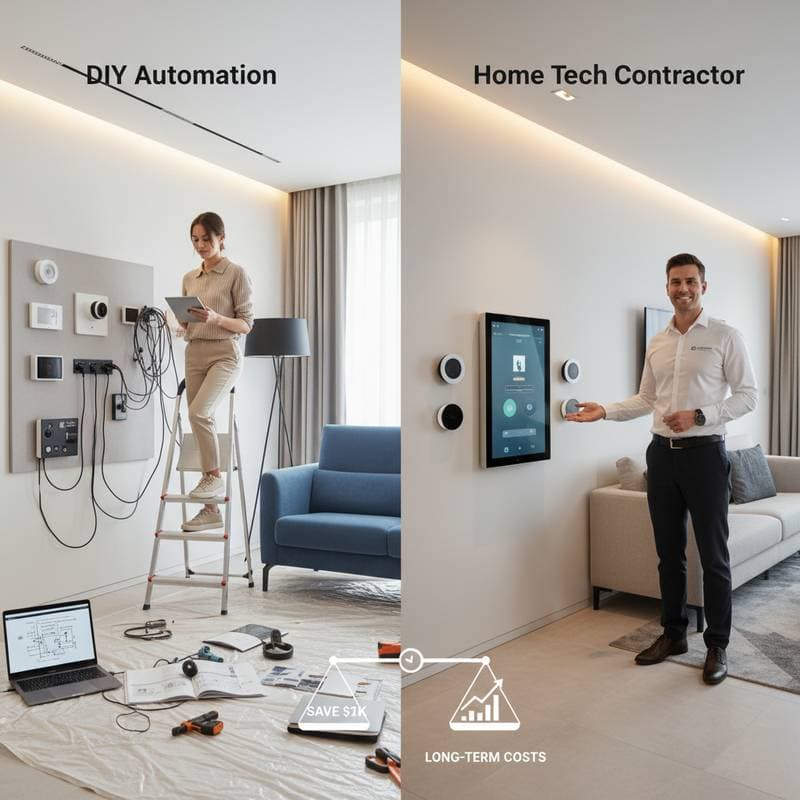
DIY Versus Professional Smart Home Installation: Which Option Delivers Greater Savings?
Homeowners frequently encounter a selection of smart devices and contemplate self-installation. The appeal of automated lighting, climate control, and security features draws many, yet installation expenses often deter progress. The core inquiry remains: Does a do-it-yourself approach yield genuine savings, or do professional services provide superior value over time?
This examination details both methods through actual cost estimates, required effort, and results. Readers gain insights to select the path aligned with financial limits, expertise, and residence characteristics, while sidestepping errors that transform enhancements into complications.
The Do-It-Yourself Approach: Customization and Initial Cost Reductions
Do-it-yourself smart home projects attract individuals enthusiastic about technology and practical tasks. Contemporary devices frequently include application-based instructions, simplifying the initiation process.
Cost Analysis
| Component | Do-It-Yourself Cost (Materials Only) | Estimated Time |
|---|---|---|
| Smart thermostat | $100–$250 | 1–2 hours |
| Smart lighting (per room) | $60–$150 | 45 minutes |
| Video doorbell | $100–$250 | 1 hour |
| Smart lock | $120–$300 | 1 hour |
| Hub or bridge | $50–$150 | 30 minutes |
A basic do-it-yourself configuration typically ranges from $400 to $1,000, influenced by device quantity and manufacturer selections. Expanding to a comprehensive residence system, incorporating surveillance and detectors, elevates expenses to $1,200 to $3,000 for equipment alone.
Benefits of Do-It-Yourself Installation
- Reduced initial expenses: Labor charges, often $75 to $150 hourly, become unnecessary.
- Gradual expansion: Additions occur incrementally, matching financial availability.
- Skill development: Personal configuration fosters comprehension of diagnostics and upkeep.
- Independent timing: Components integrate without external appointment constraints.
Challenges of Do-It-Yourself Projects
Complexity arises when combining manufacturers or linking systems. Incompatibilities demand extensive investigation. Network coverage or modem constraints frequently impair operations, resulting in unreliable automation. Furthermore, integrating thermostats or exterior surveillance may necessitate familiarity with cabling and elementary electrical protocols.
Evaluating Enduring Benefits
Initial economies from do-it-yourself efforts appear compelling, yet professional implementations minimize diagnostic durations and repair expenditures. Assess suitability through three sustained elements: dependability, scalability, and assistance.
Dependability and Efficiency
Do-it-yourself arrangements depend on wireless network robustness and interoperability. Signal variations can disrupt sequences. Professional configurations incorporate specialized controllers and cable links for consistency. Across years, stable operations conserve diagnostic efforts and avert premature replacements.
Scalability
Integrating diverse brands in do-it-yourself setups often yields multiple applications. Illumination devices require one interface, access mechanisms another, and temperature controls a third. Professionals architect unified platforms via singular controllers, streamlining interactions for households or visitors.
Assistance and Upkeep
Do-it-yourself systems demand independent resolution. Non-responsive units prompt manufacturer inquiries or online forum consultations. Professional providers frequently extend service agreements or distant oversight. Such resources prove essential for security or efficiency oversight.
Strategies to Optimize Expenses Across Methods
Both do-it-yourself and professional paths benefit from targeted tactics to curb costs while upholding standards.
- Initiate modestly: Prioritize a single domain, like illumination or environmental regulation, prior to broadening.
- Leverage discounts: Utility providers sometimes rebate intelligent temperature controls or efficiency trackers.
- Consolidate services: For professionals, grouping devices in a single session diminishes labor fees.
- Select unified platforms: Opt for aligned manufacturer lines to eliminate supplementary controllers or connectors.
- Plan routine evaluations: Professional arrangements gain from yearly reviews to forestall major disruptions.
Implementing these measures typically lowers total outlays by 15 to 25 percent.
Safeguarding Your Smart Home Investment
Sustaining a connected residence requires proactive measures to preserve functionality and efficiency. Regularly update device firmware through manufacturer applications to address vulnerabilities and enhance performance. Monitor energy consumption patterns via integrated analytics, adjusting automations to optimize utility bills without manual intervention.
For do-it-yourself users, document wiring configurations and compatibility notes in a dedicated file for swift reference during issues. Professional systems benefit from scheduled technician visits, which detect subtle degradations early. In either case, integrating surge protection for powered components shields against electrical anomalies, extending equipment lifespan and reducing unforeseen expenditures.
Ultimately, a well-maintained smart home amplifies daily convenience, from automated arrivals that activate lights and locks to energy savings that accumulate over seasons. By prioritizing these practices, homeowners secure the full return on their investment, blending innovation with enduring reliability.