
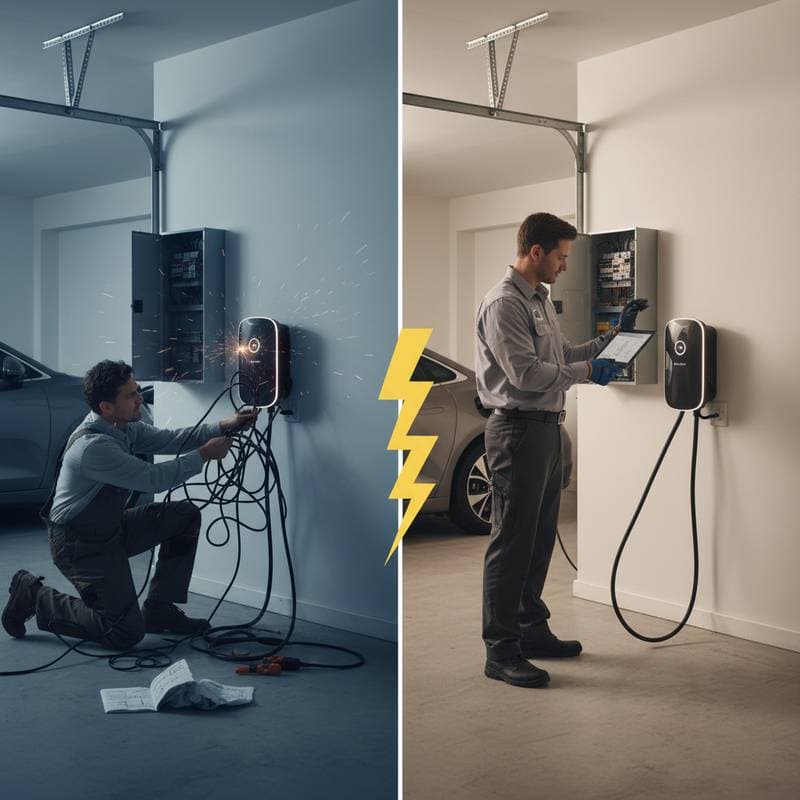
Why Professionals Outperform DIY for EV Charger Installations
Electric vehicle ownership has surged, making home charging essential for daily convenience. Owners often envision effortless overnight charging in their garage, free from reliance on public stations. However, the process of installing a Level 2 charger raises a key question: Is this a task suitable for independent completion?
Many homeowners possess experience with basic electrical tasks, such as replacing outlets or installing fixtures. Yet, EV charger installation demands far more than routine skills. This upgrade involves high-power electrical work that impacts safety, property value, and vehicle warranties. The distinction between amateur efforts and expert handling proves vital for reliable outcomes.
Key Elements of EV Charger Installation
A Level 2 charger operates on a dedicated 240-volt circuit, comparable to those for dryers or ranges. Homeowners must evaluate the electrical panel's capacity, including available amperage, appropriate wire sizes, and breaker slots.
Overloaded panels frequently require subpanel additions or full service upgrades. Professionals perform precise load calculations to confirm the system's ability to manage increased demand without frequent disruptions or thermal risks.
The procedure includes routing conduit, securing high-voltage cables, establishing grounds, and adhering to local regulations. Errors in these areas, such as improper connections or inadequate wiring, invite overheating, potential fires, or accelerated component failure.
Comparing Costs: DIY Versus Professional Services
Initial costs for a charger range from $400 to $800, varying by model and output speed. DIY enthusiasts might view this as an affordable starting point, but additional expenses for materials, permits, and corrections often escalate totals.
Expert installations generally span $800 to $2,000, influenced by home configuration and existing infrastructure. This investment covers site assessments, regulatory approvals, and comprehensive testing.
Amateur projects risk higher long-term expenses. Insurers may reject claims tied to unauthorized modifications, while manufacturers often invalidate warranties without certified workmanship. Property appraisals can also suffer from undetected code violations, complicating future sales.
View professional services as an safeguard for assets. Beyond basic assembly, experts deliver verified safety and regulatory alignment, minimizing unforeseen liabilities.
Navigating Permits, Codes, and Inspections
Electrical standards safeguard residents and maintain uniform protections. Certified electricians manage permit applications and schedule evaluations with authorities, ensuring full compliance.
Bypassing these steps invites future complications. During property transfers, unapproved alterations prompt delays or remediation demands. Certain utilities withhold service for undocumented enhancements.
Experts stay current with evolving codes and locale-specific rules. They determine optimal wire paths, breaker ratings, and protective housings for exterior units, enhancing durability and hazard prevention.
Prioritizing Safety Through Specialized Knowledge
Level 2 units sustain 30 to 50 amps over extended periods, imposing substantial residential loads. Vulnerabilities like mismatched breakers or insecure terminals produce excessive warmth and escalation risks.
Specialists employ diagnostic equipment to validate circuit integrity and voltage consistency prior to activation. They incorporate grounding protocols and safeguards such as ground-fault circuit interrupters to mitigate electrocution threats.
Independent efforts commonly overlook rigorous verification, leading to inefficiencies or hazards. Incorrect wire sizing or conduit selection results in power losses, diminished speeds, and premature degradation.
Expert oversight guarantees secure, high-performance configurations. Benefits include accelerated charging, reduced consumption, and extended service life for all components.
Scenarios Where Limited DIY Applies
Individuals with electrical training might handle minor updates, like servicing outlets for plug-in hybrids. Simple additions, such as organizers for cables, fall within safe personal scope.
Substantial modifications, including circuit additions or panel adjustments, necessitate professional intervention. Homeowners can contribute by selecting equipment, designating positions, or clearing spaces, while deferring technical execution.
Selecting a Qualified Electrician
Seek professionals with EV-specific expertise and credentials. Manufacturer directories often list vetted partners familiar with product protocols.
Inquire about these aspects:
- Permit handling: Do they oversee submissions and verifications?
- Capacity evaluation: What methods confirm panel suitability?
- Warranty preservation: Does their approach maintain product guarantees?
- Scalability: Can the design accommodate enhanced future demands?
Such discussions secure competence and align installations with evolving requirements, like multi-vehicle support.
Enduring Advantages of Expert Workmanship
Certified setups elevate property appeal. Market trends show charging capabilities as premium attributes, particularly in family-oriented areas.
Maintenance simplifies with organized labeling, detailed assessments, and archived reports. Replacements proceed smoothly, avoiding invasive repairs.
Optimal wiring ensures steady operation, promoting battery preservation through efficient energy delivery.
Practical Recommendations for Optimal Results
- Anticipate growth: Provision for dual units prepares for additional vehicles.
- Optimize placement: Position near the panel to cut wiring expenses and transmission losses.
- Secure records: Obtain duplicates of approvals, verifications, and schematics.
- Engage actively: Review the process to grasp layouts, paths, and protections.
Realizing Seamless Home Charging
With installation complete, routines streamline. Overnight connections yield ready vehicles, eliminating public dependencies.
Assurance stems from regulatory adherence and dual warranties. Upkeep involves periodic inspections and surface care, sustaining peak function.