
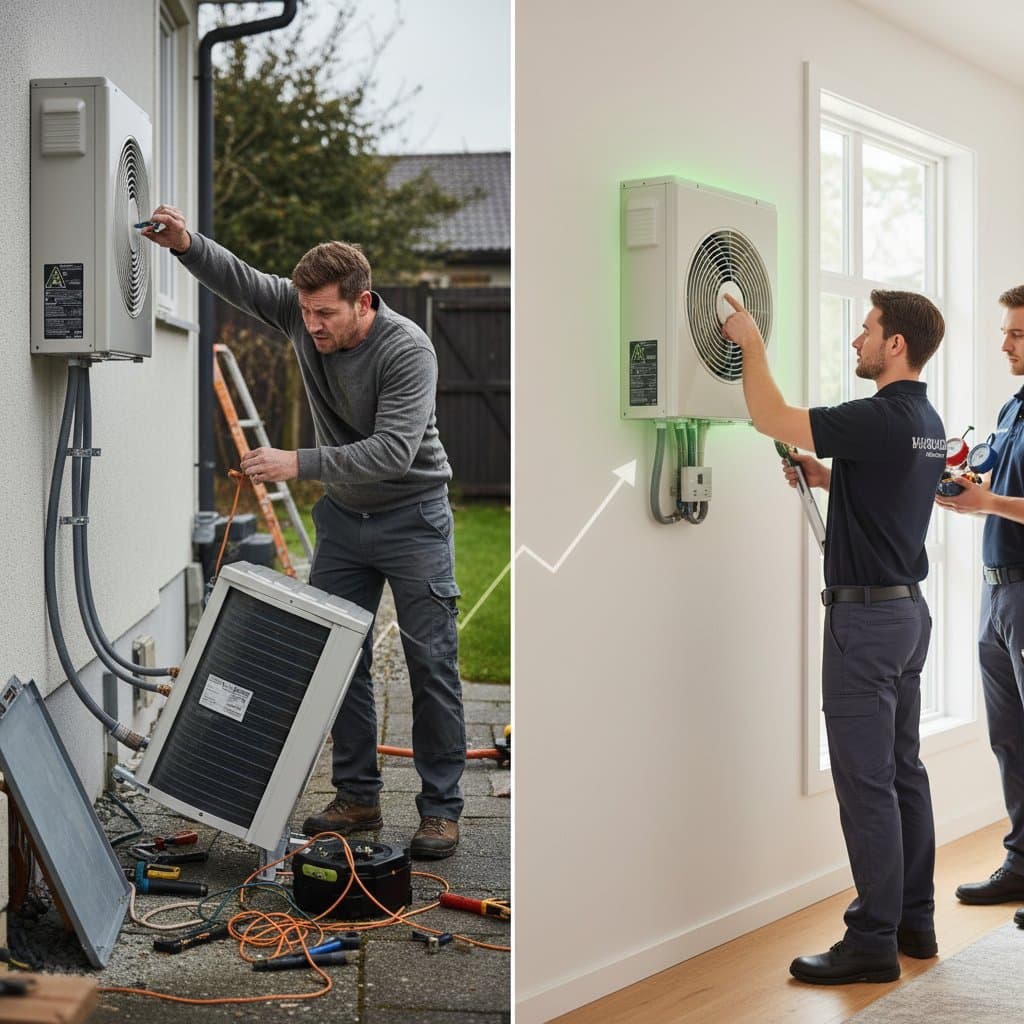
DIY Heat Pump Risks: Why Professionals Deliver Lasting Savings
Homeowners often approach a heat pump installation with enthusiasm. Tutorials and manuals suggest that handling the project personally saves significant money. Energy efficiency appeals, and the idea of self-reliance discourages hiring experts. However, the complexities involved reveal that risks frequently surpass initial cost reductions.
Picture a new heat pump unit in the driveway, tools assembled, and a free weekend ahead. Visions of reduced utility bills and reliable comfort fill the mind. Beneath the surface lies intricate work: refrigerant management, electrical connections, and precise calibration far beyond basic assembly.
Unmasking the Myth of DIY Cost Savings
Homeowners frequently start by reviewing installation estimates. Professional services range from $4,000 to $8,000, influenced by unit size, home configuration, and regional labor costs. DIY options promise to halve these figures through self-purchase and installation.
The calculation appears straightforward at first glance. Purchasing equipment alone omits essential expertise for optimal performance and durability. Faulty setup reduces efficiency by up to 30 percent, diminishing anticipated savings rapidly. Wiring errors trigger circuit breakers or harm components, while imprecise refrigerant levels accelerate wear and shorten operational life.
Small errors compound over time. A misaligned line set or inadequate duct seal leads to ongoing energy leakage. Annual heating and cooling costs rise by hundreds of dollars, erasing DIY financial advantages.
Navigating Heat Pump Installation Complexities
A heat pump functions as an integrated mechanical system, reliant on balanced airflow, pressure, and temperature control. Installation encompasses multiple technical phases:
- Load assessment to select appropriate system capacity based on home size, insulation quality, and regional climate.
- Electrical configuration ensuring proper voltage, amperage, and grounding in compliance with local regulations.
- Refrigerant line setup, involving evacuation, sealing, and accurate charging with specialized instruments.
- Unit synchronization to align indoor and outdoor components for peak efficiency.
These processes require advanced tools and certified knowledge. Refrigerant management demands EPA certification to adhere to environmental laws. Unauthorized handling invites penalties and ecological harm.
Licensed HVAC specialists possess insurance and warranties that safeguard against errors. This security forms a key element of professional service value.
Identifying DIY Safety Concerns
Hazards emerge subtly during self-installation. High-voltage elements, compressed gases, and substantial equipment heighten the chance of injury or structural harm. Standard heat pump circuits operate at 240 volts, posing severe risks upon mishandling.
Refrigerant exposure without safeguards causes oxygen displacement or tissue freezing. Beyond instant dangers, flawed setups foster concealed threats. Inadequate wiring risks overheating and fire ignition. Improper condensate drainage promotes mold proliferation and building deterioration.
Experts mitigate these issues through rigorous protocols. Insulated implements, electrical verifiers, and pressure monitors confirm secure integrations. Adherence to safety standards preserves home integrity over years.
Losing Manufacturer Warranty Protection
DIY efforts commonly forfeit vital warranty assurances. Policies mandate installation by qualified contractors to remain valid. Self-installation nullifies coverage immediately.
Repairs then burden the owner fully. Compressor replacement spans $1,200 to $2,000, and refrigerant leak corrections range from $400 to $900. Such expenses often surpass original labor savings.
Authorized installers register units for prolonged protection. Additional contractor guarantees cover labor and components for multiple years. This framework provides reliable recourse against failures.
Calculating True Efficiency Gains
Expert installations realize 90 to 100 percent of specified efficiency ratings. Self-managed systems typically achieve only 60 to 80 percent due to alignment flaws, airflow blockages, or refrigerant imbalances.
Consider a unit projected to save $600 yearly on energy. A 25 percent efficiency drop from errors equates to $150 lost annually. Across a decade, this totals $1,500, excluding heightened upkeep or early failures.
Technicians employ gauges for static pressure, superheat, and subcooling evaluations. These diagnostics validate design performance. Absent such measures, minor discrepancies strain the system, hastening degradation.
Addressing Environmental Implications
Heat pumps earn praise for transferring heat efficiently, minimizing generation needs. Benefits hinge on flawless execution. Suboptimal setups elevate energy use, countering sustainability aims.
Refrigerant escapes pose ecological risks. Contemporary formulations harm less than predecessors, yet leaks still emit greenhouse gases. Professionals execute recovery and disposal per regulations, using dedicated apparatus.
Opting for certified installation advances eco-responsibility. Systems consume less power, curb emissions, and deliver steady comfort with minimal intervention.
Unlocking Professional Installation Benefits
The enduring worth of HVAC partnerships often escapes notice. Installers facilitate ongoing care: seasonal tune-ups, filter swaps, and efficiency audits. Consistent oversight prolongs system vitality.
Specialists navigate local codes, permitting, and incentive programs. Rebates for efficient upgrades demand verified professional work. Engaging experts accesses these fiscal perks unavailable to DIY projects.
Cost Comparison: DIY Versus Professional
Examine a standard split system for an average residence:
DIY Route
- Equipment: $2,500 to $4,000
- Tools and supplies: $400 to $1,000
- Fixes or revisions: $700 to $2,000
- Overall: $3,600 to $7,000
Professional Route
- Full package: $4,500 to $8,000
- Encompasses warranty, testing, and calibration
- Rebate eligibility: $500 to $1,500
- Net: $4,000 to $7,500
Gaps diminish when accounting for performance, incentives, and safeguards. Long-term analysis favors professionals for superior returns.
Scenarios for Viable DIY Elements
Certain cases suit partial self-effort. Portable or window units facilitate easy setup with low hazards. Pre-charged mini-splits target capable individuals for basic tasks.
Even here, expert review of wiring and charging enhances safety. Hybrid models exist where contractors manage essentials like refrigerant and activation, allowing owners simpler duties. This balances expense with compliance.
Assessing Investment Returns
Heat pump value derives from efficiency, upkeep, and durability. Optimal units endure 15 to 20 years reliably. Inferior installations falter midway.
Certified setups earn efficiency badges, boosting property appeal. Buyers prioritize documented green features, with installer records proving asset.
Essential Steps for Heat Pump Upgrades
Prepare effectively with these practices:
- Solicit bids from certified contractors, evaluating service details beyond costs.
- Request load analyses to confirm sizing alignment.
- Verify credentials in refrigerants and electrics.
- Review warranty conditions prior to acquisition.
- Time projects for off-peak seasons to optimize pricing.
These measures promote clarity and sustained benefits.
Sustaining System Performance
Post-installation, upkeep simplifies longevity. Swap filters monthly to quarterly per usage. Arrange yearly inspections covering coils, refrigerants, and controls.
Clear external units of obstructions for unobstructed flow. Routine attention prevents issues and upholds efficiency.
Achieving Comfort Through Informed Choices
Selecting professional installation secures efficiency, safety, and savings. Homeowners gain reliable operation and environmental alignment. This decision elevates home value and daily living quality.